The Best Tent Peg for South African Camping: Comparison and Selection Guide
The best tent peg is the one that holds securely in the ground where you are camping, suits the load you attach to it, and can be installed properly.
That sounds simple until you move from a grassy caravan park to a sandy coastal stand, or arrive at a campsite where the ground is too hard for the pegs supplied with your tent.
A peg that worked well on your last trip may struggle on the next one. Even two stands in the same resort can have different soil beneath the grass.
For South African campers who visit different destinations, a small selection of suitable pegs is usually more useful than a large bag of one type. This guide compares the main options and explains how to choose between them.
Which tent peg is best? The quick answer
For vehicle-based camping on firm ground, robust steel pegs are a practical starting point. For loose sand, use purpose-made sand pegs or suitable sand anchors. Screw-in pegs can make pitching and removal easier, provided their design matches the ground. For hiking, lightweight aluminium stakes are often the more practical choice.
These are selection recommendations, not the results of a controlled comparison of specific brands. There is no single winner for every tent, campsite and weather condition.
| Camping condition or need | Practical first choice | Main limitation |
|---|---|---|
| Firm soil at a caravan park | Robust steel pegs, suitable V-pegs or ground-matched screw-in pegs | Check what is beneath the grass |
| Very hard, compacted ground | Steel nail or rock pegs, or a screw system specifically designed for hard ground | Stones and shallow bedrock can prevent adequate penetration |
| Loose coastal sand | Broad sand pegs, suitable long sand screws or purpose-made buried anchors | Slim ordinary pegs often have too little grip |
| Soft soil | Longer, broader pegs or suitable screw anchors | A large peg can still move if the surrounding soil is weak |
| Lightweight hiking tent | Quality aluminium Y- or V-section stakes suited to the route | Low weight may come with less tolerance of rough handling |
| Caravan tent or large awning | Ground-matched anchors at all designated structural attachment points | Groundsheet pegs are not substitutes for structural anchors |
| Frequent pitching and packing | Suitable screw-in system with compatible tools | Tool requirements and installation limits vary |
| Long-term camping | Durable, inspectable anchors with spares for changing ground conditions | No installation should be treated as maintenance-free |
Start with the ground, not the name on the packet
Words such as “heavy-duty”, “storm” and “universal” do not tell you everything you need to know.
Before buying, separate three questions:
- Can this peg enter the ground without being damaged?
- Once installed, will it resist the direction of pull?
- Does its attachment suit the rope, loop, strap or bracket you intend to use?
A narrow steel peg may enter hard soil easily but provide disappointing resistance in loose sand. A broad sand peg may grip a larger area of loose material but be difficult to install in compacted ground.
Manufacturer ranges reflect these differences.
Grass is a surface covering, not a soil description
A green campsite can have compacted clay, loose sand, imported topsoil or stones underneath it.
Ask the resort what campers normally encounter and whether there are restrictions on peg length, drilling or digging. This is particularly useful if you have a large caravan tent and limited choice about where its guy ropes must run.
The relevant question is not only “Is the stand grassed?” It is “What is the ground like where the pegs must go?”
Tent peg comparison: the main types
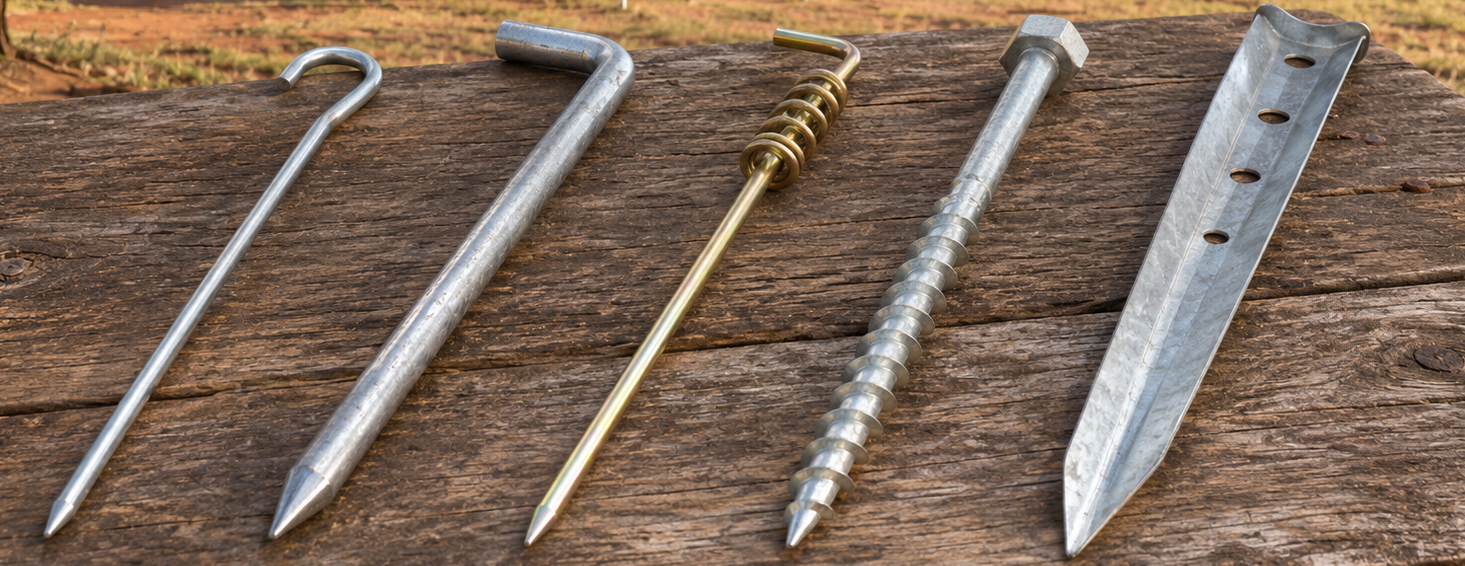
1. Thin wire pegs and shepherd’s-hook pegs
These are the familiar slender pegs with a curved hook at the top. They are commonly supplied with smaller tents and camping accessories.
Their advantages are simplicity, compact storage and usually a modest purchase cost. They can be adequate for lighter duties in cooperative ground.
Their limitations become apparent when they bend during installation, rotate under tension or pull through loose soil. A larger tent does not become securely anchored simply because every loop contains a peg.
Best suited to: lighter attachment duties in suitable ground, where permitted by the tent manufacturer.
Less suited to: being the only anchoring option for a large caravan tent, loose sand or difficult hard ground.
Do not automatically discard the original pegs. Identify which jobs they can do adequately and upgrade the points that need something more substantial.
2. Steel nail pegs and rock pegs
These use a relatively narrow, rigid shaft and a head or attachment feature. They are a sensible option to consider when thin pegs keep bending as you hammer them into firm ground.
For campers travelling by car or towing a caravan, the additional weight may be a reasonable trade-off for durability.
“Rock peg” does not mean it can be driven through solid rock. A stone may stop the point while the rest of the shaft remains exposed. Continued hammering can damage the peg or its head without improving the anchor.
Best suited to: firm or compacted ground that permits adequate insertion.
Main weakness: a narrow shaft is not automatically a good anchor in loose sand.
Check the head carefully. It must retain the intended guy line without sharp edges damaging it. A strong shaft is of limited value if the rope slips off or its plastic attachment breaks.
3. Heavy-duty round steel pegs
Longer, thicker steel pegs are a practical option for larger vehicle-based camping setups where carrying weight matters less.
However, thickness mainly tells you about the peg’s dimensions. It does not provide a reliable holding rating for your campsite.
A large peg installed only partway because it has struck stone may be a poorer choice than a suitable peg properly installed nearby.
Best suited to: larger setups in ground that allows the required penetration, subject to the shelter manufacturer’s instructions.
Main weaknesses: weight, extraction effort, corrosion and the risk of assuming that size alone guarantees grip.
4. V-pegs and angle pegs
V-shaped and angle-section pegs present a broader profile than thin round wire. Designs vary from lightweight hiking stakes to substantial steel camping pegs.
They are worth considering where an ordinary thin peg moves too easily in soil, but a dedicated sand anchor is unnecessary.
Broad profiles can be harder to drive through stones or very compacted ground. Thin sections can also deform if hammered against an obstruction.
Best suited to: general soil conditions compatible with the particular peg’s size and material.
Main weakness: two pegs described as “V-pegs” can differ greatly in strength and intended use.
5. Aluminium Y-pegs and hiking stakes
For a hiker, a heavy peg bag is a problem that a caravan camper may never notice. Aluminium stakes offer a useful balance between carrying weight and performance.
Look at the section shape, length, head and intended soil conditions rather than the word “aluminium” alone. A well-designed stake is quite different from a thin, easily bent rod.
Best suited to: backpacking and smaller tents where weight matters.
Main weakness: a lightweight stake selected for a small hiking tent should not automatically be transferred to a large caravan awning.
Use an appropriate installation method. Stamping on a peg with your boot can bend it and creates an injury risk if your foot slips.
6. Screw-in tent pegs
Screw-in pegs use a threaded or spiral design and can be installed with a compatible hand tool or powered driver, depending on the product.
Their attraction is practical: less hammering, controlled installation and the ability to reverse them out when packing up. For campers who find repeated hammering tiring, this may be a meaningful benefit.
The category includes very different products. A narrow hard-ground screw and a broad sand screw should not be judged as though they were interchangeable.
One manufacturer’s instructions, for example, distinguish between normal, sandy and difficult ground. Its regular pegs have different tool restrictions from certain heavy-duty models. Some use adjustable attachments and do not require the entire peg to be driven below the surface. Those features belong to the specified system; they should not be assumed for every screw-in peg.
Best suited to: campers wanting convenient installation with a system matched to their ground and equipment.
Main weaknesses: unsuitable ground, excessive torque, damaged heads, missing drivers and reliance on a charged battery if no hand tool is carried.
Before buying, confirm the approved tool, installation method and any torque limit. The numbered clutch settings on a drill are not a universal reading in newton-metres.
7. Sand pegs and sand anchors
Loose sand needs its own approach. Buying an ordinary peg that is merely harder to bend may not solve the problem.
Options include broad blade pegs, suitable large spiral anchors and purpose-made anchors designed to be buried. Their dimensions and method of installation matter as much as their material.
Best suited to: sandy stands and other loose ground for which the product is designed.
Main weaknesses: bulk, digging or installation effort, and uncertain performance when the sand is especially loose or shallow over rock.
A buried anchor is sometimes called a deadman anchor. Use equipment and a method intended for this purpose. Do not assume that a small bag of sand placed on the surface can replace a properly installed anchor for a loaded awning.
Ask permission before digging, protect vegetation and remove the entire anchor when leaving.
8. Groundsheet pegs
Groundsheet pegs hold matting, skirts and similar items close to the ground. Their low-profile heads may also make them easier to live around.
They have a different job from the anchors holding structural guy ropes.
Best suited to: groundsheets and other light attachments within their intended use.
Main weakness: they can look adequate while being unsuitable for the main loads on a tent or awning.
Steel, aluminium or plastic: which material is best?
Material matters, but the design and ground conditions still come first.
| Material | Useful qualities | What to check |
|---|---|---|
| Steel | Often practical for repeated driving into firm ground | Weight, shaft size, head strength and corrosion protection |
| Aluminium | Lower carrying weight; used in many shaped stakes | Alloy, section shape and approved installation method |
| Reinforced polymer | Used in lightweight screw and sand peg designs | Approved ground, torque limits, cracks and condition |
| Unspecified plastic | May be adequate for light-duty accessories | Do not assume structural strength or long-term durability |
A reinforced polymer screw is not necessarily inferior to a steel peg simply because it contains plastic. Equally, a metal peg is not automatically a strong anchor.
Compare complete products intended for the same job.
How long should a tent peg be?
There is no single length that makes a peg suitable for all South African campsites.
Consider the length that can actually engage useful ground, not just the overall measurement on the label. Also consider its width, profile and attachment position.
For a larger awning, choose according to the manufacturer’s anchoring requirements and the ground you encounter. Avoid treating a particular peg length as a guaranteed “storm specification”.
Choosing pegs for common South African camping situations
A weekend on a firm, grassed stand
Start with serviceable pegs suitable for ordinary soil. For vehicle-based camping, carry some robust steel alternatives in case the surface is compacted.
If the pegs supplied with your tent install properly and remain secure under normal setup tension, replacing every one may be unnecessary.
Spend first on missing anchors, damaged pegs and unsuitable main guy-rope anchors.
A coastal campsite with sandy ground
Ask about the actual stand. A coastal resort can have firm landscaped sites as well as loose sand.
If loose sand is expected, pack purpose-made sand anchors before travelling. Do not rely on finding suitable replacements after the wind starts.
Use the specified installation method and check each anchor in the direction its rope will pull. A hand check can identify obvious movement; it does not establish a wind rating.
A hard, dry inland stand
Robust narrow steel pegs or a suitable hard-ground screw system are worth considering.
If a peg stops abruptly, investigate or reposition it where the shelter’s layout allows. More force is not always the answer.
Pilot drilling should only be considered where the peg manufacturer permits it, the campsite allows it, and underground services have been ruled out. An oversized hole can compromise the intended grip.
Wet ground after heavy rain
Recheck the anchoring even if nothing appears to have moved. Soil conditions can change after pitching, and saturated soil can lose holding capacity.
Watch for a widening hole, leaning peg or guy line that repeatedly goes slack. If the ground cannot hold your setup securely, moving or taking it down may be more sensible than adding more tension.
Long-term caravan camping
For a longer stay, ease of inspection and removal matters alongside initial grip.
Keep spare anchors suited to the site, check ropes and attachment points regularly, and inspect pegs for corrosion, bending or cracks. Pay particular attention after rain, strong wind or changes in soil condition.
Record which peg types work on the stands you revisit. Your own notes about actual ground conditions are more useful than remembering only the resort’s name.
The best pegs for caravan tents and awnings
A caravan tent can have several different attachment jobs: main guy ropes, veranda supports, wall loops, skirts and groundsheets. These do not all require the same peg.
Begin with the complete pitching instructions. Count every designated anchoring point, including the points you may normally leave unused in calm weather.
Then separate the structural anchors from the lighter accessories. Use the ground-matched anchors where the shelter depends on them and suitable smaller pegs where their job is simply to hold an edge down.
Also check compatibility. A thick peg may not fit an eyelet; a large head may prevent a strap sitting properly; a sharp hook may abrade a rope.
The peg, connector, guy line, attachment point and pole all form part of the same setup. Improving one part does not establish the strength of the others.
Choosing and understanding tent poles
What makes a good storm tent peg?
Treat “storm peg” as a description that needs supporting detail.
Ask what ground it is intended for, how it must be installed, what attachment it accepts and whether any claimed capacity comes from relevant testing.
A peg cannot provide a universal safe wind speed for a complete campsite. Tent size, shape, exposure, anchoring layout, soil, fabric and frame condition all affect the outcome.
Do not wait until conditions become dangerous to change pegs or dismantle an exposed awning. Follow the shelter manufacturer’s weather advice and the campsite’s instructions. Stronger pegs do not remove the need to take shelter elsewhere when conditions require it.
Installing pegs without defeating their purpose
Follow the instructions for the particular peg
There is no universal angle or installation method for every straight peg, screw anchor and buried sand anchor.
Do not apply a familiar “45-degree rule” automatically to every design. Follow the peg and shelter instructions, including any requirements for the head, hook or rope position.
Keep the attachment in its intended position
Avoid leaving a long exposed shaft with the rope attached at the top when the design requires a low attachment. A raised fastening point can reduce holding capacity.
For an adjustable screw system, use its intended clip or bracket correctly. Do not improvise around a partially installed peg without checking that the design permits it.
Check before hammering, screwing or digging
Campsites may have buried water pipes, electrical cables and irrigation lines. Ask about permitted pegging areas and depth restrictions, particularly near service points.
Check the anchor under normal setup tension
Look for movement, rotation, lifting or soil breaking away. Correct obvious problems before occupying the tent.
This is a practical setup check, not a controlled pull-out test or proof that the anchor will withstand a storm.
Make the finished setup visible
Keep pegs and ropes out of walkways where possible. Use suitable visible markers or covers where appropriate, especially around children, pets and people moving about after dark.
A practical peg kit: buy for the job
For a camper visiting mixed destinations, a useful kit can include:
- Enough suitable general-purpose pegs for every required attachment point.
- Robust hard-ground alternatives for difficult positions.
- Sand anchors when sandy conditions are expected.
- Separate groundsheet pegs.
- Spares for damaged, lost or unsuitable pegs.
- A compatible hammer, puller or driver, plus a hand tool where the screw system allows one.
Count your own tent, veranda and accessories rather than buying according to a generic “complete kit” number. A kit can be well made and still contain too few suitable structural anchors for your setup.
South African supplier Tentco, for example, lists straight pegs, V-pegs, spiral sand pegs, groundsheet pegs and pile-driver sets as separate options. This illustrates the range of jobs a peg bag may need to cover; it is not a ranking of those products.
Buying checklist
Before comparing prices, check:
- Ground suitability: Is the product intended for firm soil, hard ground or sand?
- Dimensions: What are its usable length, shaft size and profile?
- Attachment: Will your rope, loop, strap or bracket fit securely?
- Installation: Which tool and method are approved?
- Removal: Can you extract it without damaging it or your equipment?
- Replacement parts: Are separate clips, drivers and pegs available?
- Quantity: Does the pack cover the relevant attachment points?
- Total cost: Have you included tools, accessories and delivery?
Avoid paying for a complete second set when a few suitable additions would solve the actual problem. Conversely, cheap pegs that repeatedly bend or fail to hold are poor value even if the packet price is attractive.
Frequently asked questions
Are screw-in tent pegs better than hammer-in pegs?
They can be more convenient to install and remove. Whether they anchor better depends on the particular design, ground and installation. Compare products intended for the same conditions.
Which tent pegs are best for sand?
Start with purpose-made broad sand pegs, suitable sand screws or buried anchors. The correct installation and the condition of the sand still matter.
Which pegs should I use in hard ground?
Consider robust steel nail or rock pegs, or screws specifically approved for hard ground. Neither option guarantees that you can penetrate buried rock.
Does a heavier peg hold better?
Not necessarily. Its weight may reflect a thicker steel construction, but holding also depends on shape, installation and soil. Weight alone is a poor buying guide.
Can I use an impact driver for screw-in pegs?
Only if the particular model permits it. Manufacturer instructions can differ even within one brand’s range. Do not assume that all screw-in pegs tolerate the same tools.
Will two pegs give twice the grip?
Do not assume so. Spacing, connections and how the load is shared affect a multi-peg arrangement. Use a manufacturer-supported system rather than treating two neighbouring pegs as a known capacity upgrade.
Can I use one type of peg for everything?
Possibly, if your equipment and ground conditions stay consistent. For varied camping, a mixed kit gives you more options when the usual peg will not install or hold properly.
Choosing the best tent peg for your camping
Begin with where you camp most often. Choose suitable anchors for that ground, then add alternatives for the conditions that have caused problems before.
For many caravan and vehicle-based campers, robust steel pegs make a useful starting point on firm ground. Sand requires sand-suitable anchors. Screw-in systems are worth considering where easier pitching and removal matter. Hikers will place more emphasis on carrying weight.