
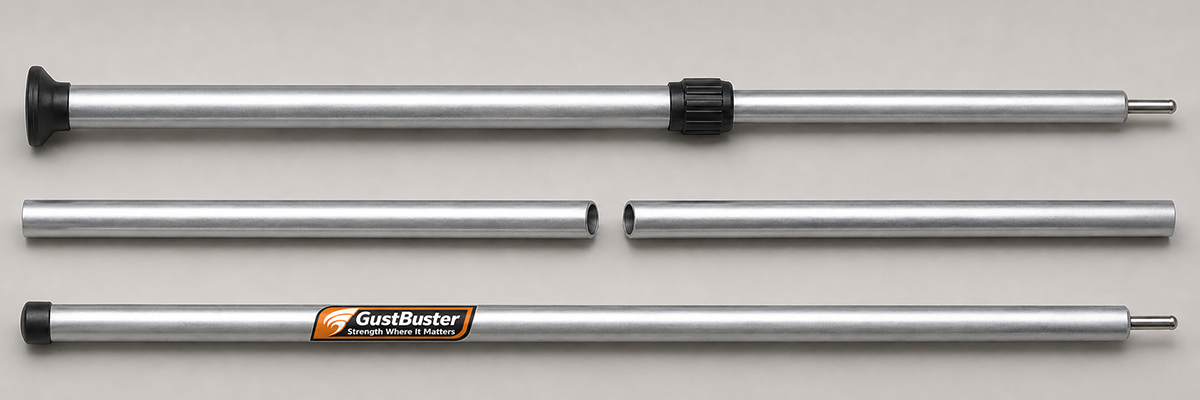
Tent Pole Information Guide: Telescopic Poles, Replacement Sections and GustBuster
A tent pole can look like a simple piece of tubing until you need to replace one. Then the questions start. Does 22 mm refer to the inside or outside diameter? Will the new section fit your existing lower pole? Does it include the spigot and clamp? And does a reinforced pole replace the whole telescopic assembly?
This guide explains how tent poles work, what to measure before buying, and how to choose between a complete telescopic pole and a reinforced replacement section such as GustBuster. The main focus is caravan tents, patios, verandas and camping awnings commonly used in South Africa.
The most important distinction: a complete telescopic pole provides an adjustable assembly. GustBuster is a reinforced pole section used in a compatible assembly. The GustBuster section described here excludes the spigot, clamp and bottom 25 mm pole.
What does a tent pole actually do?
Tent poles establish the shape of a shelter and support its fabric. Depending on the design, they may stand vertically, run along the roof, span between uprights or bend into an arch.
Their job involves more than holding up the weight of the canvas. Wind pushes against the fabric, guy ropes pull on attachment points, and rainwater can add weight if the roof sags. These forces travel through the fabric, poles, joints, ropes and anchors.
A pole therefore works as part of a system. A stronger tube can address a weak section, but it cannot correct a slipping clamp, loose peg, damaged eyelet or poorly pitched roof.
Before buying anything, identify which part of that system needs attention.
The main types of tent poles
| Pole type | How it works | Common applications | What to check |
|---|---|---|---|
| Telescopic pole | One tube slides inside another and locks at a chosen length | Caravan tent uprights, patios and awnings | Working length, overlap, tube sizes and locking mechanism |
| Fixed-length pole | A single tube or connected sections provides a set length | Tent frames and specific support positions | Exact length, connectors and end fittings |
| Sectional flexible pole | Short sections join into a pole designed to bend | Dome tents and hiking tents | Tent model, diameter, section lengths and end fittings |
| Replacement pole section | Replaces one part of an existing pole | Repairing an otherwise serviceable assembly | Compatibility with every adjoining part |
| Reinforced pole section | Includes additional material or a changed construction to reinforce the section | Selected replacement or upgrade applications | Reinforcement details, fit and evidence behind strength claims |
These categories overlap. For example, a telescopic assembly can contain a reinforced upper section. “Telescopic” describes the adjustment method; “reinforced” describes the construction.
A rigid caravan pole should not be substituted for a flexible dome-tent pole. Flexible poles form part of a deliberately curved structure and must match the tent’s requirements.
How a telescopic tent pole works
A typical two-piece telescopic upright has a larger lower tube and a smaller upper tube. The upper section slides into the lower section, and a clamp or other locking mechanism holds the chosen height.
Depending on the product, the assembly may include:
- A lower tube and foot or ferrule.
- An upper tube.
- A clamp, collar or other adjustment mechanism.
- A spigot or another top fitting.
Some designs use three sections or a different arrangement. Always check the actual product rather than assuming every telescopic pole has the same construction.
What does 25/22 mm mean?
In a typical 25/22 mm assembly, the larger tube has a nominal outside diameter of 25 mm and the smaller tube has a nominal outside diameter of 22 mm.
The smaller tube slides inside the larger one. However, the nominal outside sizes do not tell you everything about fit. The larger tube’s wall thickness determines its internal opening, and dents, coatings, manufacturing tolerances and fittings can reduce the available clearance.
For example, a tube with a 25 mm outside diameter and 1.2 mm wall thickness has a calculated inside diameter of:
25 − (2 × 1.2) = 22.6 mm.
That is a dimensional example, not a promise that every 25 mm pole accepts every 22 mm section. Measure the actual parts and check the clamp arrangement.
Why overlap matters
The overlap is the length of upper tube that remains inside the lower tube when the pole is extended.
This connection needs sufficient engagement to transfer loads between the sections. Pulling the upper section almost completely out concentrates movement and stress around the joint.
Two 1,500 mm sections do not automatically provide a usable 3,000 mm pole. Some length must remain overlapped. For illustration, a 300 mm overlap would leave a combined tube length of 2,700 mm, before allowing for the particular fittings. This example is not an approved overlap specification for your pole.
Follow the pole supplier’s maximum extension and minimum overlap instructions. If these are unavailable, obtain them before relying on the pole at full height. Do not assume that tightening the clamp harder compensates for insufficient overlap.
The clamp matters as much as the adjustment range
A clamp must hold the section without slipping or damaging the tube. A pole that gradually drops under ordinary use may have a worn clamp, contamination on the gripping surfaces, an incorrect tube size or another compatibility problem.
Repeatedly tightening a faulty clamp can dent the tube or damage the mechanism. Support the roof, remove the load and inspect the parts before making adjustments.
A complete telescopic pole versus GustBuster
If you arrived here while looking for a telescopic pole, it helps to separate the complete product from a replacement section.
GustBuster serves a different purpose. It is a reinforced section intended to replace a compatible section within an existing pole assembly. It does not provide all the components of a complete telescopic pole.
| Feature | Maxcons 2.4 m telescopic pole, as listed by its supplier | GustBuster section described in this guide |
|---|---|---|
| Product supplied | Complete telescopic pole assembly | Reinforced replacement pole section |
| Main purpose | Provide an adjustable support pole | Reinforce a compatible pole assembly by replacing a section |
| Tube arrangement | 25/22 mm telescopic tubes | Nominal 22 mm outer tube with an internal reinforcing tube |
| Length | Supplier lists extension up to 2.4 m | Section length of 1,500 mm |
| Height adjustment | Through the supplied telescopic assembly | Depends on the compatible lower section and clamp used with it |
| Spigot | Included in the supplier’s listed assembly | Included |
| Clamp | Included in the supplier’s listed assembly | Excluded |
| Bottom 25 mm pole | Part of the listed telescopic assembly | Excluded |
| Foot | Plastic foot listed | Does not supply the complete assembly’s lower foot |
| Main check before buying | Required working height and suitability for the tent | Section, fitting and overlap compatibility |
A 1,500 mm GustBuster section is not a complete 1,500–2,400 mm telescopic pole. Its length describes the supplied section, not the adjustment range of a finished assembly.
Similarly, replacing an upper section does not automatically give your existing pole the extension limit of another manufacturer’s product. The completed assembly must remain within the requirements of its components.
How GustBuster is constructed
The GustBuster specification used for this guide is:
| Component | Specification |
|---|---|
| Outer aluminium tube | Nominal 22 mm outside diameter, approximately 1.2 mm wall thickness |
| Supplied section length | 1,500 mm |
| Internal reinforcing tube | Private |
| Reinforcing tube length | 1,200 mm |
| End detail | A plug at one end |
| Excluded components | Clamp, bottom 25 mm pole and other assembly accessories |
The reinforcement is inside the supplied section. It is separate from the larger lower tube that allows a completed telescopic assembly to adjust in height.
Because the reinforcing tube is shorter than the outer section, the construction is not identical along the full 1,500 mm length. The location of the reinforcement and the load applied to the section matter when assessing its performance.
The end plug is also not a spigot. Its presence should not be interpreted as an additional pole connection or as evidence that all fittings are included.
What does the reinforcement achieve?
GustBuster is intended to improve the section’s resistance to bending through internal reinforcement. The precise improvement depends on the materials, how the tubes work together, the reinforced length and the way the assembled pole is loaded.
Tube dimensions alone do not establish a verified percentage improvement or a safe wind speed. A meaningful comparison would need a defined test arrangement and results for both the reinforced section and the ordinary section being compared.
For that reason, this guide does not claim that GustBuster is unbreakable, assign it a wind rating or promise that it will protect every other part of a tent.
Should you buy a complete pole or replace a section?
Choose a complete telescopic pole when you need a new support position, do not have a suitable lower tube and fittings, or have an assembly with several damaged components. A complete product can also be the simpler choice when compatibility cannot be established.
Consider a replacement section when the remaining assembly is sound and the replacement matches its dimensions, fittings and intended working length.
Consider GustBuster when you want a reinforced section for a compatible assembly and understand which components you must reuse or obtain separately.
For example, if the upper section of a patio pole has bent while the lower section and clamp remain sound, a compatible replacement section may be useful. If the clamp is cracked and the lower tube is dented as well, replacing only the upper section leaves those problems unresolved.
Do not reuse a suspect component merely because it still fits together.
How to measure a tent pole before ordering
Take measurements with the pole unloaded and, where the design permits it, separated into its components. A vernier calliper is more useful than estimating a diameter with a tape measure.
1. Identify the pole’s position
Record whether it is a front upright, centre upright, roof support, ridge pole or another component. Include the tent or awning make and model if known.
A replacement that works vertically is not automatically suitable as a horizontal roof member. The direction and distribution of loading differ.
2. Measure each section’s outside diameter
Measure undamaged tubing away from clamps, dents and flared ends. Record the actual reading rather than rounding everything to the nearest familiar size.
“About 22 mm” may be adequate for an initial enquiry. It is not enough to confirm compatibility with a close-fitting component.
3. Check the lower tube’s internal opening
Measure the inside diameter where practical, and check for internal obstructions. A tube can be round at its open end yet damaged farther down.
If a section will not slide freely, do not hammer it into place.
4. Record lengths separately
Write down the replacement section’s full length, the lower section’s length, the required erected height and the specified overlap.
Do not measure only the exposed portion of the upper tube while the tent is standing. That omits the part hidden inside the lower section.
5. Check the spigot and fittings
Record the spigot diameter, exposed length and attachment method. Photograph the top of the pole, the clamp and the lower end.
An existing spigot that fits ordinary hollow tubing may not fit the reinforced section in the same way. Confirm the supplied end arrangement and available clearance before planning to transfer fittings. Avoid drilling or modifying a reinforced section without the maker’s instructions.
6. Confirm what is included
Before paying, establish whether the listing supplies one tube, a reinforced section, a complete pole or a set of poles.
For a GustBuster enquiry, provide your measurements and photographs and ask whether the section matches your assembly. This is more reliable than assuming that the words “caravan tent pole” mean a universal fit.
Aluminium, steel and fibreglass tent poles
Aluminium
Aluminium is widely used where carrying weight and corrosion resistance matter. It does not develop the familiar red rust of ordinary steel, but it can still suffer corrosion, pitting, wear and damage.
Anodised and bare aluminium have different surface finishes. Follow the maker’s cleaning advice, especially before using metal polish on a coated or anodised surface.
Steel
Steel is common in substantial tent frames. The weight of an assembly depends on its dimensions and construction, but steel tubing is heavier than aluminium tubing of the same dimensions.
Painted, plated or galvanised finishes help protect the underlying material. Check scratches, joints and tube ends, where deterioration may be easier to miss.
Fibreglass and other flexible pole materials
Fibreglass poles commonly appear in sectional dome-tent frames. These poles are designed to flex into a specific shape. Replace them with the correct specification rather than selecting a rigid tube because it appears stronger.
For model-specific poles, the section lengths, connectors and end fittings can be as important as the diameter. Outwell’s spare-parts process, for example, uses identifying information to establish the correct replacement. [2]
Is a thicker or larger pole always better?
Diameter, wall thickness, material, unsupported length and joint design all influence behaviour. Increasing wall thickness generally adds weight as well as material, while a larger outside diameter can affect bending resistance and compatibility.
However, a larger pole that does not fit your clamp or roof connection is not a useful upgrade. Nor does a thicker tube fix inadequate overlap.
Choose a suitable assembly, rather than judging a pole by one measurement.
Why tent poles bend, slip or fail
Wind loads and movement
Wind acts on the shelter’s fabric, and the resulting loads reach the supporting frame and anchors. Loose fabric can flap, while an inadequately supported structure can move out of shape.
MSR explains that wind performance depends on several factors and emphasises correct guying and staking to help preserve the pole structure’s shape. It does not give one universal wind-speed threshold for its tents. [3]
The same caution is useful when assessing a pole upgrade: one component does not establish the wind capability of the whole shelter.
Excessive extension
A pole extended beyond its intended working range may have too little overlap and a long unsupported upper section. Use a pole designed for the required height instead of extracting the last few centimetres from an unsuitable assembly.
Water pooling
A sagging roof can collect water, increasing the load and encouraging further sagging. Ten litres of collected water adds approximately 10 kg of mass, excluding the fabric itself.
Correct the roof shape and support arrangement before rain arrives. Do not try to lift a heavily loaded pool with a bare pole tip, which can concentrate force on the fabric. Keep people clear of an unstable roof and reduce the load safely.
Excessive tension
Tension should establish the intended shape without forcing the frame into distortion. Pulling every rope as tightly as possible can overload fittings, seams and poles.
Use the tent manufacturer’s pitching instructions, and reassess the setup if excessive force seems necessary to make it stand correctly.
Existing damage
Dents, flattened sections, cracks and damaged connectors deserve attention even if the pole still assembles. A sharply kinked pole should not be treated as restored simply because it has been bent straight again.
Replace damaged structural components before the next trip, particularly where they support a large caravan tent or patio.
Setting up poles for a more dependable campsite
Begin with the tent or awning’s intended layout. Fit the correct sections in the correct positions, secure the connections and establish the required roof slope.
Then check that:
- Telescopic sections retain the specified overlap.
- Clamps hold without visible damage or slippage.
- Feet sit on a suitable, stable surface.
- Spigots and roof fittings engage correctly without stretching or puncturing fabric.
- Guy ropes use the intended attachment points.
- Pegs suit the ground and remain secure under tension.
- The roof has no obvious low pockets where rain can collect.
Extra supports can help when the shelter is designed to accept them. Isabella, for example, describes additional rafter poles as an option for improving the stability of its awnings. That guidance relates to compatible awning components, not to placing arbitrary poles anywhere beneath the roof. [4]
For a veranda or patio, assess the entire front row and its ropes and anchors. Replacing selected upper sections may address one weakness, but the centre support, corner connections and anchoring still need attention.
With severe weather forecast, consider taking down the awning or patio before conditions deteriorate. Stronger poles do not remove that decision.
Reflective sheets and additional roof covers
An extra sheet introduces another surface for wind to act on. Its attachment method determines where those loads go.
Do not assume that reinforcing the tent poles automatically makes them suitable for supporting an additional cover. Follow the cover’s instructions, provide the intended support and anchoring, and avoid sharp or unsuitable contact points against fabric.
Where a cover is designed for independent anchoring, secure it accordingly. Also check that its ropes do not distort the main tent or introduce unexpected sideways loads to the uprights.
Caring for tent poles during long-term camping
Inspect poles periodically during an extended stay, rather than waiting until packing day. Coastal salt, blown sand, moisture and repeated movement can affect tubes and fittings.
Remove dirt and salt deposits with suitable gentle cleaning, dry the components and inspect joints, feet and clamps. Where disassembly is permitted, check the hidden overlapping sections as well.
Avoid applying oil or polish to gripping surfaces unless the clamp manufacturer recommends it. A shiny tube is not an improvement if its clamp no longer holds properly.
Keep spigots and sharp fittings away from fabric during transport. Pack poles so that other equipment cannot crush them, and label model-specific sections to make the next setup easier.
Repairing or replacing a damaged pole
First reduce the load and make the area safe. Inspect adjoining parts, because the visible bend may not be the only damage.
Some flexible tent poles can be temporarily supported with a purpose-made repair sleeve. MSR describes this as a field repair followed by a permanent repair after the trip. [5]
That does not establish a suitable repair method for a large caravan upright. A taped splint or improvised join should not be assumed to restore the original strength of a heavily loaded pole.
For a damaged caravan pole, replacing the affected section or complete assembly is generally the practical route once compatibility and the condition of the remaining components have been checked.
Frequently asked questions
Is GustBuster a complete telescopic pole?
No. The version described here is a 1,500 mm reinforced section. It excludes the bottom 25 mm pole, clamp and spigot.
Can GustBuster replace the upper section of any 25/22 mm pole?
Do not assume universal compatibility. Check the actual dimensions, clamp, fittings, required height and overlap. Nominal tube sizes are a starting point, not a fit guarantee.
Does GustBuster include a spigot?
No. The end plug is not a spigot. Confirm whether your existing spigot is suitable or whether a separate compatible fitting is needed.
Will a reinforced pole stop a tent from blowing down?
No individual pole can guarantee that. The outcome also depends on the shelter, connections, anchoring, ground, pitching and weather. Reinforcement addresses a component, not every possible failure point.
Can I use a longer upper section to make my pole taller?
Only if the resulting assembly is suitable and its working limits are confirmed. Changing section length affects the exposed length, overlap and loads at the joint.
Should I replace all my poles at once?
Not necessarily. Inspect the full setup and identify damaged or unsuitable components first. A targeted replacement can make sense where the rest of the assembly remains sound.
Can I compare poles by a claimed wind speed?
Only if you understand what was tested and under which conditions. A report that a pole survived a particular storm is useful experience, but it is not a controlled rating for every tent, campsite or wind direction.
Choosing the right tent pole
Start with the job the pole must do, the required working height and the parts you already have. Measure before ordering and check exactly what the product includes.
If you need the complete adjustable assembly, choose a suitable telescopic pole. If your existing assembly is sound and you want to replace a compatible section with a reinforced one, GustBuster may be an option.
Before ordering GustBuster, provide the tube measurements and clear photographs of the clamp and end fittings so that compatibility can be checked. This avoids buying a section when you need a complete pole, or buying a complete pole when one suitable replacement section would solve the problem.
Sources
- Maxcons: Telescopic Pole 2.4 m — supplier description of the complete 25/22 mm assembly and included fittings.
- Outwell: Request spare parts — identifying the correct model-specific replacement.
- Cascade Designs/MSR: How much wind can my MSR tent withstand? — limitations of a universal wind rating and the role of guying and staking.
- Isabella: Securing your awning in a storm — compatible additional awning supports.
- MSR: Tents and Shelters owner’s manual — temporary repair sleeves for appropriate tent poles.
Publisher notes — remove this section before publishing
Suggested SEO title: Tent Pole Guide: Telescopic Poles & GustBuster
Suggested slug: tent-pole-information-guide
Suggested meta description: Understand telescopic tent poles, sizes, fittings and replacements. See how a complete pole differs from a GustBuster reinforced section.
Primary search topic: tent pole information guide.
Supporting search phrases: telescopic tent poles, aluminium tent poles, caravan tent poles, replacement tent pole sections, reinforced tent poles, 22 mm tent pole, 25 mm tent pole.
Internal links to add using confirmed live URLs:
- Link the first useful GustBuster buying reference to the current product page.
- Link the anchoring discussion to Storm Tent Pegs and Anchoring and the Tent Anchoring Comparison.
- Link the ground-selection discussion to the Screw-in Tent Peg Guide where relevant.
- Link the additional-cover discussion to Silver Reflective Camping Sheets and the TentProtek page when available.
Live Real World Camping URLs could not be verified during research, so none have been invented.
Product facts: GustBuster dimensions and exclusions are based on Nico’s supplied product specifications, including the 1,200 mm reinforcing insert and the exclusion of the spigot. Confirm these against the exact version being offered before publishing. No independently verified strength percentage or wind rating was supplied.
Old-page context: The exact former Maxcon Camping page content could not be retrieved. The complete-pole comparison uses the current Maxcons supplier listing, not an assumed reconstruction of the former page. The reference is included to orient redirected visitors, not to imply that GustBuster is the same product, a rebrand or an official successor.
Redirect: This deliverable is article copy only. Confirm the exact old page URL and the final published guide URL before configuring the permanent redirect. No redirect or website change has been made.
Recommended explanatory image: Use photographs of the actual products. Show a complete telescopic assembly beside the GustBuster section. Label the complete assembly’s upper tube, lower tube, clamp, spigot and foot. Label GustBuster “Reinforced section only — spigot, clamp and bottom pole excluded”. Show the end plug clearly without presenting it as a functional accessory. Use an accurately drawn separate cutaway only if needed to show the internal reinforcement.
Suggested image alt text: Complete telescopic tent pole compared with a GustBuster reinforced replacement section.
2 thoughts on “Tent Pole Information Guide”
Comments are closed.