
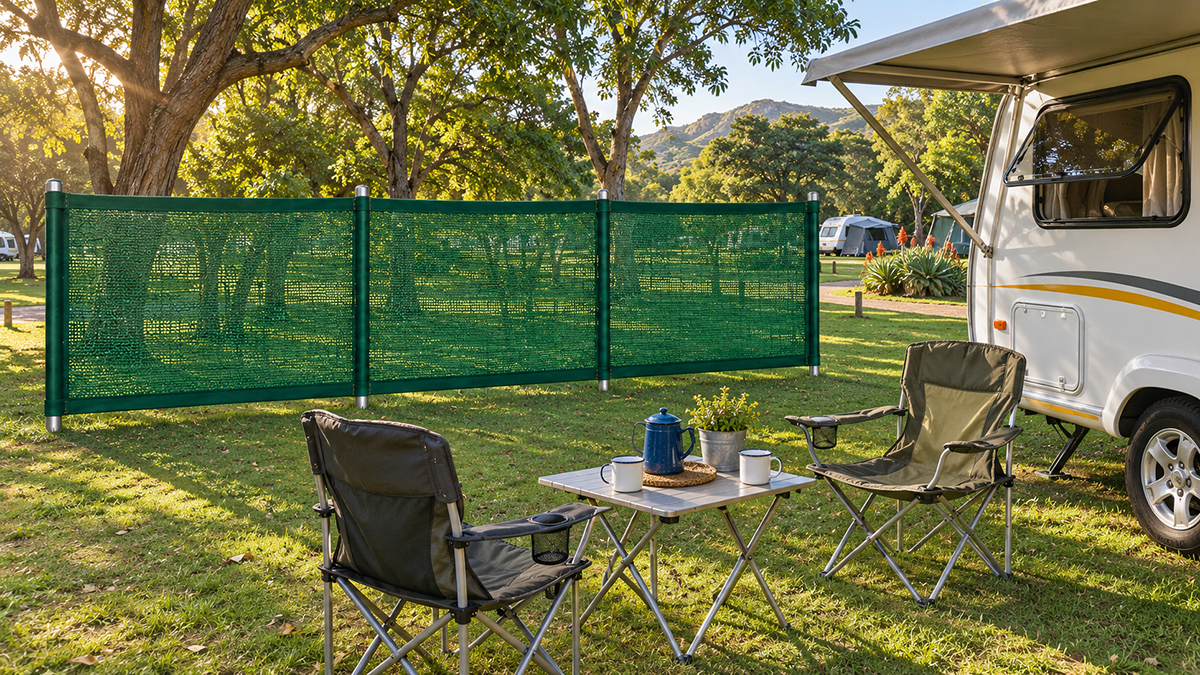
Camping Windbreakers: Choosing, Positioning and Anchoring a Campsite Windbreak
A camping windbreaker can make the difference between enjoying your outdoor space and spending the afternoon inside the caravan. It can soften an uncomfortable breeze around your chairs, provide some privacy and help define the area where you sit and eat.
But a windbreaker also adds another structure that needs to be supported and anchored. Buying the biggest screen or the thickest material does not automatically give you the most useful shelter.
The material, height, layout, poles and ground all matter. So does knowing when to take it down.
This guide explains how camping windbreakers work, what to look for and how to use one around a caravan or tent. It also explains the wind-management principle behind WindMod, our camping windbreak concept at Real World Camping.
What is a camping windbreaker?
A camping windbreaker is a portable screen supported by poles or another frame and secured to the ground. Campers also call it a windbreak, wind screen, wind barrier or camping lapa.
Here, “windbreaker” means the campsite screen, rather than the jacket. “Camping lapa” usually describes an enclosure around part of the stand; it does not necessarily include a roof.
The most useful way to think about a camping windbreak is as a way to reduce wind in a particular outdoor living area.
It is not a storm shelter. A low screen cannot be assumed to protect a much taller tent, awning or caravan roof from damaging gusts.
What can a camping windbreaker do?
Start with the problem you want to solve.
| Your main need | What to consider |
|---|---|
| More comfortable outdoor seating | Airflow through the material, screen position and shelter at seated height |
| More privacy | Fabric visibility, screen height and changing light conditions |
| Less windblown sand around chairs | Low-level coverage, wind direction and gaps at the ends and bottom |
| A defined campsite living area | Layout, access and the space needed for guy ropes |
| Frequent moves between campsites | Packed size, weight and how easily you can erect and dismantle it |
| Longer stays | UV exposure, repairable components and ongoing inspection |
One windbreaker may meet several of these needs, but there are trade-offs.
A screen that gives good privacy may restrict airflow more than you want on a hot day. A long enclosure may work well on a spacious stand but leave no safe room for guy ropes on a smaller one.
A fabric boundary is also not a secure fence for children or pets. Do not rely on it to prevent a child or dog from leaving the stand.
How does a camping windbreak work?
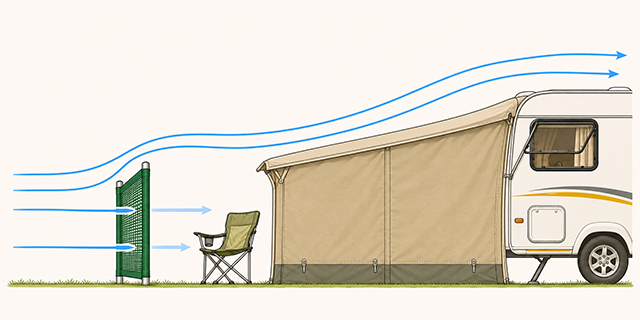
Wind meeting a screen can pass through it, move over it or travel around its ends. The balance depends on the material and the layout.
A windbreak cannot be a 100% shield against storm winds because it cannot fulfill the role of a wall.
A porous screen allows some air through while slowing the flow. A solid screen diverts more of the air over and around it. This can create a calmer patch close behind the screen, together with disturbed, swirling air elsewhere.
Research on windbreaks shows that porosity affects both the amount of wind reduction and the turbulence behind the barrier. Very dense barriers generally produce more turbulence than moderately porous ones. Height, length and the incoming airflow also affect the result.
For campers, the practical lesson is straightforward: a windbreak does not need to stop all airflow to be useful.
The aim is a more comfortable place to sit, while retaining enough ventilation for the conditions.
Why there is no fixed sheltered distance
Windbreak research often describes shelter in multiples of the barrier’s height. Much of that research concerns long fences or shelterbelts in relatively open terrain.
A short camping screen beside a caravan is a different setting. Its ends, nearby tents, buildings and changing wind direction all influence the airflow.
Do not assume that a 1.5 m screen creates a guaranteed calm zone a particular number of metres behind it. Use the general principle, then check the actual result where your chairs and table will stand.
Mesh, shade net or solid fabric?
The fabric determines much of how a windbreaker behaves, but the fabric alone is not the complete product.
Purpose-made windbreak netting
Windbreak netting is intended to provide a penetrable barrier. It is worth considering when your main aim is to moderate wind while allowing air through.
For example, Knittex lists campsite wind and privacy screens among the applications for its windbreak netting. Its standard Code 40 material uses a mottled green-and-black yarn configuration, and the manufacturer describes the material as HDPE with UV stabilisers.
That identifies the material and its intended use. It does not establish the strength or wind rating of every finished camping screen made from it.
Shade net
Shade net is used in camping windbreakers, but its shade rating needs to be understood correctly.
An 80% shade rating is not a claim that the material reduces wind speed by 80%. A shade percentage describes light screening under the relevant specification. Wind performance depends on how air moves through the fabric and on the installation.
Fabric weight is another separate measurement. A specification such as 120 g/m² tells you the mass per square metre. It does not, on its own, tell you the safe wind speed or the holding strength of the finished screen.
Ask what the material was designed to do and what wind-performance information is available. Avoid choosing solely by colour, apparent thickness or a large percentage on the label.
Solid canvas or coated fabric
Solid screens can offer privacy and reduce direct draughts. Some campers prefer them for a sheltered seating area in cool conditions.
However, they provide less through-flow and transfer wind loads into the supporting structure. Their suitability depends on the frame, anchoring, exposure and manufacturer’s instructions.
Solid material is not automatically unsuitable, just as mesh is not automatically safe in strong wind. Both need a complete, correctly installed support system.
Comparing the options
| Material | Potential advantage | Main trade-off |
|---|---|---|
| Purpose-made windbreak netting | Designed to moderate airflow through a porous barrier | Privacy may be limited; performance depends on the installation |
| Shade net | Can provide shade, partial privacy and some wind reduction | Shade percentage does not establish wind reduction |
| Solid fabric | Stronger visual screening and less direct airflow through the panel | More air is diverted around the screen; frame and anchor loads need attention |
| Fabric with clear window sections | Maintains some outward visibility | Clear sections are still solid surfaces; they do not provide ventilation |
Choosing the height and length
Measure the living area you want to shelter before deciding how much screen to buy.
Height: match the screen to how you use the space
If the problem is wind around your legs and upper body while seated, a screen near seated head height may be useful. Standing privacy is a different requirement and may need a taller screen.
Taller screens also present more area to the wind and apply loads higher above the ground. Increasing height therefore changes the demands on the poles and anchors.
Check the view as well. Some campers want shelter without losing sight of the sea, river or children playing nearby.
Length: measure the layout, not just the caravan
A 10 m screen does not provide a 10 m frontage once you turn part of it around a corner.
For example, a three-sided arrangement with a 4 m front and two 3 m returns uses 10 m of fabric. That is a planning example, not a recommended layout for every stand.
Mark out the intended shape with a rope. Include the chairs, table, access route and space outside the screen for anchors.
Consider where you will walk after dark. A windbreaker that only fits when its guy ropes cross the entrance is too large for that arrangement.
Packed size matters too
Check the longest packed pole, the total weight and whether the bag will fit where you intend to store it.
For campers who move often, a manageable screen that goes up easily may be more useful than a large enclosure that becomes a chore at every stop.
Where should you position a camping windbreaker?
Place the main screen on the side from which the troublesome wind is arriving. Begin with it broadly across that airflow, then assess the comfort of the seating area behind it.
Watch the wind at chair height. A forecast describes the wider area; trees, buildings and neighbouring caravans can change the flow on your particular stand.
Leave clearance between the screen and your tent or caravan. Fabric and poles can move under load, and a screen should not be able to rub against windows, paintwork or tent fabric.
Straight, angled or three-sided?
| Layout | Where it can be useful | What to check |
|---|---|---|
| Straight screen | Wind mainly arriving from one direction | Air moving around the ends; enough width for the seating area |
| L-shaped arrangement | Shelter needed along a front and one side | Corner support and separate tension in each run |
| U-shaped arrangement | A more enclosed living space | Ventilation, entrance position and sufficient anchoring room |
These shapes are options, not structural guarantees. A corner does not automatically make a windbreaker storm-resistant.
Follow the product’s supported layouts and pole positions. Do not create long unsupported sections just to achieve a particular shape.
Leave an easy exit
Keep the entrance clear of guy ropes and place it where it does not direct the main draught straight into your seating area, where practical.
Leave access to caravan doors, service connections and equipment. Check the resort’s rules before enclosing a stand or putting anchors near paths and neighbouring pitches.
Poles: diameter is only part of the answer
A pole’s outside diameter does not tell you everything about its strength.
Other factors include:
- The material and its grade.
- Wall thickness.
- Unsupported length.
- Joints, connectors and locking mechanisms.
- The width of fabric supported by each pole.
- Guy-rope position and tension.
Steel and aluminium poles can both be suitable when correctly specified. It is not useful to declare one universally stronger without comparing their dimensions and construction.
Pole feet need attention too. A pole that sinks, slides or rotates changes the tension in the screen and its guy ropes.
Will stronger poles solve a failing windbreaker?
Only if the poles are the limiting component and the rest of the system can support the loads.
A stronger pole does not improve weak stitching, damaged eyelets or pegs pulling out of loose sand. It may simply move the failure to another part of the system.
Treat the windbreaker as a complete assembly: fabric, reinforcement, poles, attachments, ropes, anchors and ground.
Anchoring a camping windbreaker
Anchoring needs to suit the ground on the day. The pegs supplied in a kit may be convenient general-purpose pegs without being suitable for every campsite.
| Ground condition | Practical consideration |
|---|---|
| Firm soil | Use compatible anchors installed to their intended depth and orientation |
| Hard or stony ground | Use a peg intended for that ground; do not force a delicate anchor against buried rock |
| Loose sand | Consider purpose-made sand anchors with greater holding area |
| Soft or waterlogged soil | Reassess holding power and whether the screen should remain up |
| Paving or restricted ground | Use only an approved anchoring arrangement; check resort rules |
Before driving or screwing anchors into the ground, check for campsite services and ask management where necessary.
Do not assume that a peg is secure because it resisted the first few turns or hammer blows. Equally, a peg that has become loose should not be treated as reliable merely because it is still in the hole.
Guy ropes and tension
Use the intended guy points and the manufacturer’s arrangement. The ropes must support the poles against the directions in which they may be loaded.
Avoid pulling the screen so tight that the poles bow or attachments distort. Excessive slack is also undesirable if it lets the fabric repeatedly snap against its supports.
Aim for controlled tension within the product’s instructions. Some movement is expected in flexible camping equipment; tightening every rope harder is not a universal cure.
Mark ropes where people may walk and keep them within your stand.
Keep the windbreaker independently supported
Do not casually tie a freestanding windbreaker to an awning pole, caravan handle or tent attachment. That introduces additional loads into something that may not have been designed for them.
Use a shared connection only where the equipment manufacturer expressly provides for it.
Why gusts deserve attention
Wind loading rises rapidly as wind speed increases.
The standard drag relationship includes the square of wind speed. With other factors unchanged, doubling the speed means approximately four times the aerodynamic force.
For illustration, increasing from 20 km/h to 40 km/h is therefore a much bigger loading change than the numbers may suggest.
This is not a rating for any camping windbreaker. Real fabric screens flex, change shape and allow varying amounts of airflow through them. The example explains why a setup that looks comfortable in a steady breeze may behave very differently in a gust.
When should you take the windbreaker down?
There is no universal safe wind speed for camping windbreakers. A defensible rating must apply to the complete product and its stated installation conditions.
Plan to dismantle before the weather makes handling a large screen difficult.
Warning signs include:
- Pegs moving or pulling free.
- Pole feet slipping or sinking.
- Poles bending significantly or joints moving.
- Fabric repeatedly snapping hard against supports.
- Stitching, sleeves or attachment points starting to fail.
- A forecast or warning beyond the setup’s stated limits.
Check the current South African Weather Service information and resort guidance. Do not rely only on how sheltered the campsite feels at that moment.
If conditions are already dangerous, prioritise people and safe shelter. Do not risk injury trying to save a screen.
A practical setup sequence
- Check the weather and stand rules. Decide whether conditions are suitable for erecting the screen at all.
- Mark the living area. Include chairs, entrances and the full anchor footprint.
- Inspect the components. Look for damaged fabric, bent poles, worn ropes and loose fittings.
- Lay out the screen. Identify each pole position and guy point before lifting it.
- Erect and support it progressively. Follow the manufacturer’s sequence and use a helper where needed.
- Adjust tension evenly. Avoid pulling one panel tight while leaving the next unsupported.
- Check from inside and outside. Look for rubbing, trip hazards, gaps and moving anchors.
- Sit in the intended area. Judge the shelter where you will use it and adjust the layout if needed.
Inspect again after the first breezy period and after rain or a wind-direction change.
Long-term and coastal camping
A screen used every day for several months experiences a different duty cycle from one used on occasional weekends.
Ask whether the fabric, stitching, poles and fittings are suitable for that exposure. UV-stabilised material still needs inspection; the term does not mean it will last indefinitely.
For longer stays, make inspection part of your routine:
- Check seams, pole sleeves and eyelets for wear.
- Look for fraying where fabric touches fittings.
- Remove sand and salt deposits as directed by the supplier.
- Check metal fittings and pole ends for corrosion or damage.
- Recheck anchors after rain and ground disturbance.
- Pack the screen clean and dry.
Use cleaning methods approved for the fabric. Aggressive chemicals, abrasion or pressure washing can cause damage.
Windbreakers, braais and gas cooking
A campsite windbreaker is not a fire screen.
Keep braais, hot surfaces and sparks well away from fabric, ropes and poles, allowing for movement in the wind. Maintain the clearances specified for your cooking equipment and comply with resort fire restrictions.
Do not turn the cooking area into a poorly ventilated enclosure.
A campsite screen is also different from a close-fitting stove windshield. Some gas stoves expressly prohibit windscreens because trapped or reflected heat can overheat the fuel canister. Follow the instructions for your particular appliance; do not improvise a wraparound shield.
WindMod: The Wind Manager
WindMod is our camping windbreak concept at Real World Camping, built around a practical aim: moderating wind in the space where campers sit and spend time outdoors.
The name “The Wind Manager” describes that approach. The intention is to allow some airflow through a porous screen while making the area behind it more comfortable.
A useful windbreak needs more than suitable netting. Its layout, supports and anchors must also suit the campsite and conditions.
When considering WindMod, use the same questions you would ask of any camping windbreak: What area will it cover? What is included? How is it anchored? What are its limitations? Check the current product information for the final specification, availability and setup instructions.
What does a netting manufacturer’s wind-reduction figure mean?
Knittex reports an approximate 35% reduction in wind velocity on the leeward side for its windbreak netting. That is the netting that WindMod is made of.
That is a manufacturer statement about the netting. It should not be presented as a measured result for a complete WindMod installation, a guarantee at every chair position or a safe operating wind speed.
Finished-product performance requires its own evidence, including the layout, measurement positions, incoming wind and ground conditions. That distinction matters when comparing products and deciding what to expect.
Questions to ask before buying
A useful product description should help you establish:
- The erected height and length, and the supported layouts.
- The fabric type and any relevant manufacturer specifications.
- Pole material, dimensions and number of supports.
- Whether poles, ropes, pegs and a bag are included.
- Whether the supplied anchors suit your usual ground.
- Packed dimensions and total weight.
- Setup and dismantling requirements.
- Availability of replacement or repair parts.
- Any tested wind limits and the conditions attached to them.
Compare the cost of a usable system, including any additional anchors you need. A fabric-only price is not directly comparable with the price of a complete kit.
Frequently asked questions
Does a camping windbreaker stop the wind completely?
No. A porous windbreak allows some air through, and air can also travel over and around it. The useful outcome is reduced wind in part of the area behind the screen.
Is a higher shade percentage better for wind protection?
Not necessarily. Shade percentage does not measure wind reduction or establish the strength of the complete screen. Choose according to the intended use, material information and support system.
Can a windbreaker protect my tent during a storm?
Do not rely on it for that purpose. A low screen may alter airflow around part of a tent, but it does not make the tent stormproof. The tent still needs its own correct pitching, anchoring and weather precautions.
Is a camping lapa the same as a windbreaker?
The terms are sometimes used interchangeably for portable campsite screens. Check the description: a camping lapa may refer to an enclosure and does not necessarily include a roof.
Will it keep sand out?
It may reduce windblown sand in part of the sheltered area, but it cannot make the space sandproof. Wind direction, ground-level gaps and airflow around the ends affect the result.
Can I use shade cloth to make my own windbreaker?
Yes, but choosing cloth is only the start. You also need appropriate edge reinforcement, pole supports, attachment points, ropes and anchors. A sheet of netting with a few eyelets is not automatically a reliable windbreak system.
Can I leave it up overnight or when I go out?
Base that decision on the forecast, product instructions, ground and your ability to respond if conditions change. If unsuitable weather is expected while you are away or asleep, dismantle it beforehand.
Is WindMod stormproof?
WindMod should not be described as stormproof. Its purpose is campsite wind management. Use the current product instructions and any documented limits when deciding where and when to erect it.
Choose for the space where you actually camp
Start with the area you want to make more comfortable. Match the screen to that space, leave room for anchoring and choose materials for the balance of wind reduction, ventilation and privacy you need.
Good positioning and suitable anchors are part of the product’s usefulness. So is being able to pack it away before conditions exceed what it can reasonably handle.
Sources and further reading
- Heisler, G. M. and DeWalle, D. R. (1988). Effects of windbreak structure on wind flow. Agricultural windbreak research used here for general airflow principles, not as a camping-product performance rating.
- Knittex. Windbreak Netting. Material details, campsite applications and the manufacturer’s approximate leeward wind-velocity reduction statement.
- NASA Glenn Research Center. Drag Equation. Basis for the wind-speed-squared loading explanation.
Research checked: 10 November 2026.