
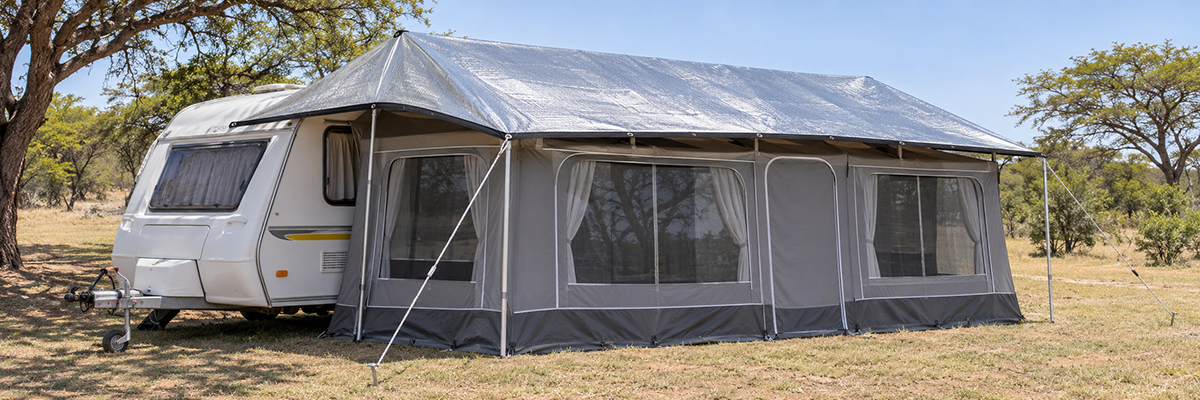
Do Silver Reflective Sheets Keep Tents and Caravan Awnings Cooler?
On a hot December afternoon, you can sit in the shade of a caravan tent and still feel the heat coming off the canvas above you. That is where a silver reflective sheet can help. It shades the roof before the canvas heats up. You may feel more comfortable underneath, even when the thermometer shows only a small change.
How much difference it makes depends on where the sun reaches your tent, how freely air can move and which material you choose.
How does a silver reflective camping sheet work?
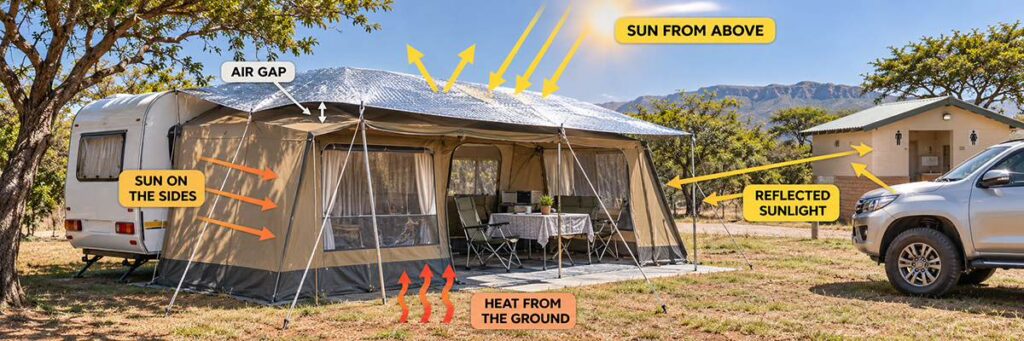
A silver reflective camping sheet is a removable cover that you put over a tent, caravan awning or outdoor sitting area. South African campers also call it a silver seil. If you are looking for a silver seil vir ’n karavaan, you will come across both open shade netting and solid fabric covers.
Both types intercept sunlight that would otherwise reach the canvas. Some sunlight reflects off the upper surface. The sheet itself can still get warm. Where the design allows it, leaving an air gap with open sides gives warm air a way out from between the two layers. Inside the tent, open ventilation panels help carry warm air away from the living space.
Will the tent be 5°C or 10°C cooler? There is no reliable figure for every setup. A closed tent on hot paving and a well-ventilated tent on grass can give different readings under the same cover.
The roof is only one source of heat. If low afternoon sun comes through the open side of your awning and falls directly on your chair, a roof cover alone will do little for you at that time of day. Before choosing a size, look at where the shade actually falls when your stand is hottest.
Reflective shade netting or solid silver canvas?
Start with what you need the cover to do. If your tent roof already keeps the rain out and your main problem is heat, breathable netting is a practical choice. If you also want a dry sitting area beyond the tent, look for a solid cover specified for rain.
| What matters on your stand | Reflective shade netting | Solid reflective fabric |
|---|---|---|
| Shade and airflow | The open weave provides shade while allowing some air through. | The fabric shades the area below. Airflow beneath it depends mainly on the gap and open edges. |
| Rain | Water or mist can pass through the openings. | A waterproof fabric with suitable seams can shed rain when pitched with enough slope. |
| Wind | Some air passes through, although gusts still pull on the fittings and anchors. | A solid sheet catches more wind than a comparable open net. Support and anchoring need particular attention. |
| Handling | Knitted netting is often light and flexible. | Coated or laminated covers can be heavier. Compare the finished weight for the size you need. |
Some reflective nets are knitted from high-density polyethylene (HDPE). When comparing them, look for the shade rating, whether the material is UV-stabilised for outdoor use and what the supplier says about solar reflectance.
An 85% shade rating describes how much light the net screens out under the stated test conditions. It cannot tell you how much cooler your tent will be.
A silver finish alone also tells you little about how one net will perform against another.
How to measure and fit a reflective sheet
- Measure over the roof. Follow the slope from the eave up to the ridge and down the other side. Then measure the length you want to shade. A tent’s floor width can underestimate how much material you need over a pitched roof.
- Plan the overhang on your stand. Check where the afternoon sun comes in, whether the door can open fully and where the guy ropes will run. Extra width is useful only if you have room to support and anchor it.
- Leave a path for air. Follow the fitting instructions for the sheet and tent. Keep ventilation openings clear. If the design uses a ridge spacer, check that it spreads the load without rubbing the canvas or pressing hard on one part of the frame.
- Check where the pull goes. Use reinforced attachment points and anchors suited to the ground. If the sheet is designed for independent anchoring, run its guys to their own anchors. Check the awning maker’s guidance before asking a pole or frame fitting to carry an extra load.
- Allow for changes in the weather. Pitch a rain cover so that water can run off without collecting in pockets. Check the guys and pegs again after rain, especially if the soil has softened. Follow the maker’s wind guidance and lower or remove the cover ahead of strong winds while conditions still allow you to handle it safely.
Working sizes for South African caravans
The figures below cover the main tent section. For models where I could verify the caravan width but could not establish the tent dimensions, the last column shows what the span would be if the tent projects 2.40 m.
| Caravan and reference version | Tent length along caravan | Tent depth | Caravan overall width | Approx. combined horizontal span |
|---|---|---|---|---|
| Jurgens Penta, version reviewed by CaravanSA | ±4.60 m | ±2.40 m | 2.318 m | 4.72 m. Tent and body figures come from separate sources. |
| Sprite Swing, 2016 specification | Measure | Confirm fitted tent | 2.16 m | 4.56 m with a 2.40 m tent. |
| Sprite Splash, 2016 specification | Measure | Confirm fitted tent | 2.16 m | 4.56 m with a 2.40 m tent. |
| Jurgens Fleetline, 2017 specification | Measure | Confirm fitted tent | 2.35 m | 4.75 m with a 2.40 m tent. |
| Jurgens Exclusive, 2015 specification | Measure | Confirm fitted tent | 2.35 m | 4.75 m with a 2.40 m tent. |
| Sprite Tourer SP, 2016 specification | Measure | Measure fitted awning | 2.185 m | Measure the pitched setup. A revised SP/SW awning has front and rear roof pitches. |
Download a pdf that shows how to measure the sheet for different uses:
What matters if you camp for weeks or months?
A cover can spare the tent roof some direct sun and catch leaves and bird droppings before they reach the canvas. The amount of protection depends partly on how open the material is. Check underneath from time to time, clear out trapped debris and give damp canvas a chance to dry.
For a long stay, look closely at the places that will keep moving in the breeze. Start with an eyelet and follow the pull of the guy rope back into the sheet. Is the eyelet set into reinforced webbing? Does the stitching spread the pull over a wider area? A well-made attachment matters as much as the fabric between the corners.
There is no single service life for a reflective sheet. Two weeks of December sun each year is a different proposition from months of continuous exposure on the coast. When comparing prices, check what you get for the size quoted, whether ropes and fittings are included, and whether a damaged attachment can be repaired. Ask whether the warranty covers continuous outdoor use and whether it extends to the stitching, webbing and eyelets. A warranty on the netting itself may cover only the material.
Reflective camping sheets from RealWorldCamping
We are developing a reflective camping sheet range for South African tents and caravan awnings. Our focus is on shade, airflow beneath the cover and reinforcement where the sheet is supported and anchored.
The range is still in development. We will publish confirmed sizes, material specifications, prices and ordering details once the sheets are ready for sale.
RealWorldCamping — From Problem to Product.
Check the afternoon sun before you peg out your silver sail.
On the Web: Open SunCalc, find your stand on the map and select your camping date. Check where the sun will be at 15:00 and again at 17:00. Then look towards that side of your stand. Will a tree or the caravan already shade your chairs, or will the low sun shine in under the edge of the sail? A spot that is comfortable at lunchtime can be in full sun by the time you put the kettle on.
Download an Android App.
7 thoughts on “Silver Reflective Sheets for Tents and Caravans.”
Comments are closed.