
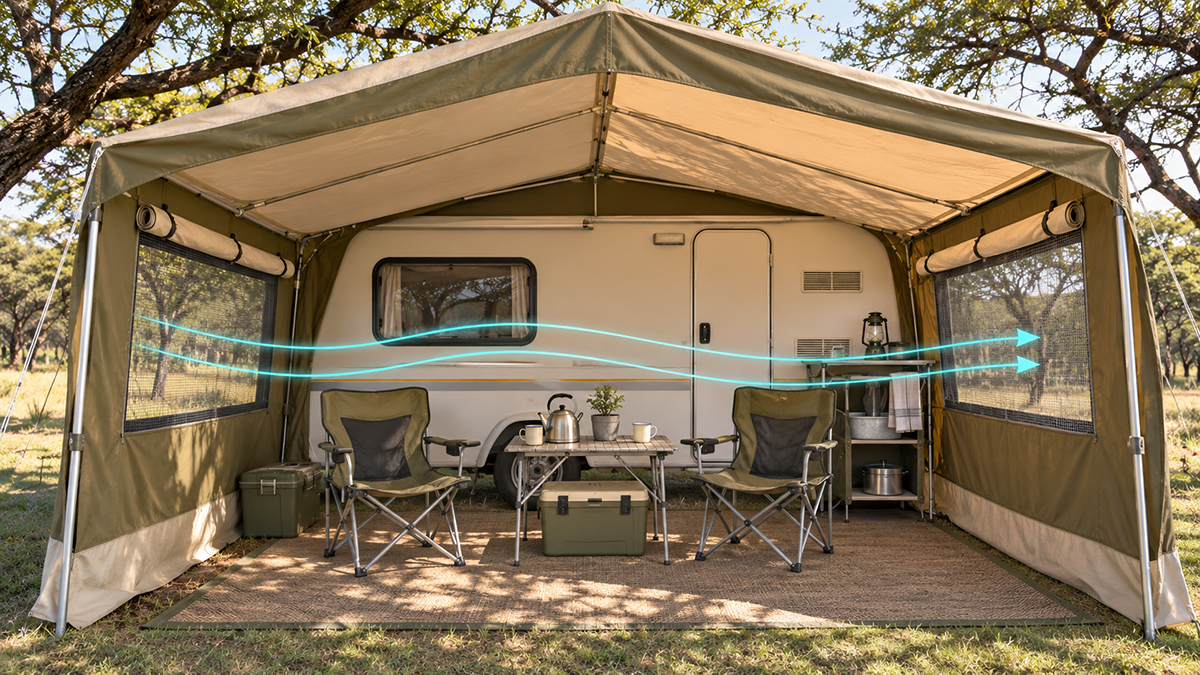
How to improve airflow in a tent or caravan awning
You can sit in the doorway of a caravan tent, feel a pleasant breeze on your face and still climb into a stuffy bed ten minutes later. The front panel may have been open all afternoon. The question is whether any of that air passed through the sleeping area.
To improve tent ventilation, open a screened window on the side catching a gentle breeze, then open a second window or vent beyond the place where you sit or sleep. In a caravan awning, that second opening may be on the far side of the caravan itself. Check the result at chair or pillow height. A flap moving at the entrance tells you very little about the far corner.
Which tent windows should you open?
Start with two openings on different sides.
A breeze pressing against one wall creates a small difference in air pressure between that wall and the more sheltered side. Opening both gives air a route through the tent. This is called cross-ventilation.
Suppose the door and kitchen window are open at the front of a family tent, but the beds are at the back. Before unzipping more of the door, try the window behind the beds. Open the fabric cover, leave the insect mesh zipped and check that the bedroom divider allows air through. If the mattress still feels sheltered, hold a loose strip of tissue at pillow height. Try another window and see which arrangement moves the tissue.
This simple check is most useful when you change one opening at a time.
Before pitching, look at what will stand immediately outside those windows. A rear vent facing a solid hedge and a side window behind the parked bakkie may have little breeze to work with. Sometimes moving the bakkie is easier than turning the tent.
Choose the pitch and orientation for the weather you expect. An arrangement that catches a light afternoon breeze may be unsuitable when strong gusts are forecast.
How do you ventilate a caravan with a full tent attached?
Once the full tent is up, the caravan door opens into another room. If the awning walls are zipped and warm, opening that door simply connects the caravan to a warm awning. Start outside and trace the route all the way to the bed or dinette.
| What you want to ventilate | What to try in a gentle breeze |
|---|---|
| The awning seating area | Roll up the side panel catching the breeze. Open a panel beyond the chairs and check the airflow while seated. |
| The caravan bedroom | Open a screened awning panel, the caravan door and an outside-facing caravan window near the bed. If the breeze comes from the window side, the same route can work in reverse. |
| A zip-in sleeping compartment | Open the compartment’s mesh panel and the matching outer window or vent. Check that the rolled fabric clears both openings. |
| An awning with one wall kept up for privacy | Leave that wall in place. Try openings on adjacent sides and move the chairs into the path between them. |
A tall cupboard beside the door can deflect the breeze. A towel draped across mesh can close the most useful window in the tent. If the passage feels cool and the dinette feels stuffy, look for those obstructions before buying a fan.
What works when there is hardly any wind?
Use the height your tent gives you.
When the air inside is warmer than the air outside, some warm air can escape through an upper vent as replacement air enters lower down. Open the tent’s peak vent or the caravan’s roof hatch as conditions allow, then open a lower screened window.
On a still evening when indoor and outdoor temperatures are close, expect little natural draught.
This is where a small rechargeable fan earns its space. Aim it across the bed for a breeze on your skin.
To clear a pocket of hot air from a sleeping compartment, try placing the fan at its opening, blowing out, and open a screened window behind the bed so air can replace what the fan moves.
A fan running inside a zipped compartment mainly circulates the air already there.
If the afternoon sun is beating directly onto the canvas, deal with the roof as well. A silver reflective camping sheet shades the roof. The tent windows exchange the air around the occupants. A raised cover can leave a passage for air above the canvas while the bedroom underneath remains stuffy. After fitting the sheet, stand inside and check that its edge still clears the windows and that the peak vent can open fully.
Why is the flysheet wet in the morning?
Two people can add moisture to a tent overnight simply by breathing.
Wet towels, swimming costumes and damp ground add more. When moist air meets a flysheet cold enough for water vapour to condense, droplets form on its underside. A fairly even film of droplets after a rainless night points towards condensation. A drip that repeatedly starts at the same seam during rain deserves a separate leak check.
Before bed, put wet gear somewhere sheltered outside the sleeping compartment. Set the flysheet so it clears the inner tent as designed, open the protected vents and pull bedding away from the walls. On a damp coastal night, the incoming air may already carry plenty of moisture. You can still wake to a wet flysheet with the vents open. Keep the bedding clear of it and give the fly time to dry when conditions improve.
How do you keep air moving when it rains?
During a Highveld shower, first close the opening taking rain.
Check whether a hooded vent or a window on the sheltered side can stay partly open without letting water reach the bedding. Check again if the shower changes direction. In strong winds, follow the pitching and storm instructions for your particular tent or awning.
Keep the braai outdoors and clear of tent openings. Even cooling coals release carbon monoxide, a poisonous gas you cannot see or smell. Never move a braai into a tent, caravan or awning to get it out of the rain, even with a panel rolled up.
A final check before you turn in
The last person to bed often changes the ventilation without realising it.
Down comes the privacy flap, the divider gets zipped and a towel goes over the rear window. Once the tent is set up the way you will actually sleep in it, lie down and check again. Can outside air reach the pillow, and is there an opening for it to leave?
That is the arrangement worth remembering for tomorrow night.
1 thought on “Tent Airflow and Ventilation”
Comments are closed.