Reflective sheets vs shade cloth for camping: Which should you buy?
If your caravan tent already keeps the rain out and you want shade over the roof, start by pricing knitted shade cloth. If you want a dry place to sit beyond the edge of the awning, look for a solid reflective sheet that the supplier rates as waterproof. If you want a sun cover that fits your tent and has reinforced places to tie it down, a purpose-made silver shade-net cover is worth a closer look.
That third option matters. In South Africa, a “silver sheet” or silwer seil can be a solid coated fabric or a knitted net. Two covers can look much the same in a product photo and behave quite differently in the first shower.
Before comparing prices, ask what the sheet is made of and what you need it to do.
Reflective sheet or shade cloth at a glance
| What matters at camp | Ordinary knitted shade cloth | Silver knitted camping cover | Solid reflective camping sheet |
|---|---|---|---|
| Best reason to buy | Affordable shade in a size you can cut yourself | A ventilated second roof with a camping-specific fit and tie-downs | Shade plus rain cover if the finished sheet is waterproof |
| Airflow | Air can pass through the knit | Air can pass through the knit. The amount depends on the fabric | Air moves through the gap under the sheet and out at the open edges |
| Rain | Water passes through | A dense knit may shed some rain, but water can still come through | Performance depends on the coating, seams and slope |
| What the price buys | Often bare fabric sold by the running metre | Check the finished dimensions, reinforced edges and attachment points | Check the water rating, finished weight and hardware supplied |
| Main buying mistake | Pricing the net and forgetting the cost of finishing it | Assuming a silver colour proves a cooling advantage | Assuming every silver tarp is waterproof |
Which gives better shade over a hot tent?
Start with where the sun lands.
If it beats down on the roof of a dome tent from breakfast to lunchtime, an overhead cover makes sense. If your caravan awning is comfortable at midday but the late-afternoon sun reaches under the front edge, a larger roof sheet may buy very little extra shade. A removable shade-cloth panel on the sunny side can put the shade where your chairs actually stand. Leave an opening for the breeze.
For a second roof, look at coverage, shade factor and the space between the layers. A silver coating can reflect some incoming sunlight. A knitted cloth shades the canvas by intercepting sunlight before it reaches the roof. Either cover can work better when pitched clear of the canvas with open edges so air can carry warmth away.
Laying an expensive sheet flat against the roof gives up that ventilation gap.
A useful South African example comes from the Colourshade Z25 fabric specifications. The manufacturer lists its standard charcoal at 94% shade factor and 95% UV block, and its standard silver at 88% shade factor and 93% UV block. In that particular range, charcoal provides the deeper shade. The figures describe shade and ultraviolet protection. Neither measures total solar reflectance or tells you how many degrees cooler your tent will be. Ask for the figures for the exact fabric and colour you are buying.
When is a solid reflective sheet worth the extra money?
Consider a Highveld campsite where you want to leave a table and chairs outside the awning during an afternoon shower. Shade net will give you somewhere to sit while the sun is out. A waterproof reflective flysheet can also give you a dry area, provided it has enough slope to drain and the runoff falls clear of the entrance.
Read the wording on the exact model. One South African supplier sells two versions of its silver camping cover. It describes the aluminised ripstop canvas as waterproof and the lighter coated polyester as water resistant. The lighter version may suit a camper who packs up every few days. If keeping the table dry is the reason for spending more, confirm that the waterproof claim covers the finished sheet, including any joined seams.
For a caravan tent with a sound waterproof roof, a second waterproof layer may add weight and cost for a job the original canvas already does. A knitted cover lets that roof handle the rain while the outer layer takes the direct sun.
What does a camping cover cost in South Africa?
Take a 3 m × 4 m cover as an example. It gives you 12 m² of fabric and has 14 running metres of outside edge. Both measurements matter when you price a DIY cover.
| Local price example | Listed price | What it buys |
|---|---|---|
| 80% shade cloth on a 3 m wide roll | R100 per running metre | Four metres costs R400 for a 3 m × 4 m cut before finishing |
| 90–95% shade cloth on a 3 m wide roll | R150 per running metre | Four metres costs R600 before finishing |
| Stitching service listed by the same retailer | R14 per metre | One pass around a 14 m perimeter adds R196 if that rate applies to the job |
| Made-to-order reflective camping sheet | R1 800 displayed, with 4 m × 3 m listed as the first size | The supplier describes reinforced webbing and includes inflatable spacers. Confirm the price for your selected size |
Prices checked on 16 November 2026. These are examples from South African listings. Delivery, hardware and custom work can change the total.
On those figures, the R400 piece of net comes to R596 with the illustrative perimeter stitching alone. You still need to price any webbing, reinforced corners, eyelets or loops, ropes and supports you need. A sewn hem also uses some of the cut dimensions. If you already own the poles and can finish the net yourself, DIY has a clear cost advantage. If you have to pay someone to make the whole cover, get a quote for the finished size before deciding.
What are you paying for in a purpose-made shade-net cover?
Look closely at the point where a guy rope meets the sheet. Pulling on an eyelet fitted through a single layer of net concentrates the load around that hole. A reinforced attachment sewn into edge webbing spreads the pull over more material. Ask for a close-up photograph of a corner and a side attachment. They tell you more about the construction than a photograph of a neatly pitched tent.
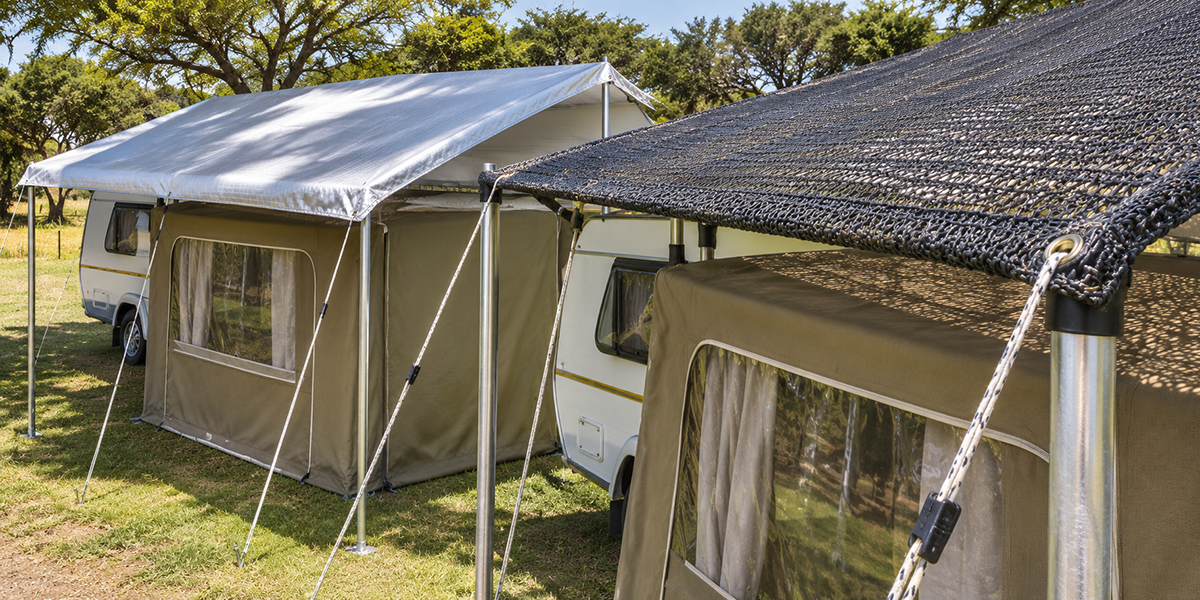
Fit matters just as much. A ready-made rectangle is convenient if its ties line up with usable support points. On a caravan awning with a pronounced ridge or an unusual projection, a made-to-measure cover may be easier to pitch clear of the roof. That is the thinking behind RealWorldCamping’s TentProtek roof protector: a knitted second skin for campers who want shade over their existing canvas.
Before you order, measure the roof you actually pitch
- Measure the erected tent or awning. Record the length along the caravan and measure over the roof slope. On a freestanding ridge tent, measure up one side and down the other. The floor footprint alone can leave you short of fabric.
- Decide where the shade or runoff must end. Open the caravan door and check clearance. Mark where the ropes would land on a typical stand and whether anyone would have to step over them to enter.
- Ask for finished dimensions and packed weight. A nominal roll width, a cut size and a finished hemmed width can be different. The weight of the complete cover matters if you expect two people to lift it over a caravan tent.
- Price the complete setup. Ask what comes with the sheet, what supports it above the ridge, and whether poles, guy ropes, pegs and a bag are extra.
- Check limits for your type of camping. For a long coastal stay, ask whether the warranty covers prolonged use, stitching and attachment points. A fabric UV warranty says little about the whole assembly. On an exposed stand, make sure you can take the cover down before strong winds arrive. Even knitted cloth presents a large surface to a gust.
Which would we buy?
- For a campsite that needs an inexpensive patch of afternoon shade, ordinary shade cloth is the sensible starting point.
- For repeated use over a caravan tent, compare a finished DIY quote with a purpose-made knitted cover of the same size.
- Spend the extra on a waterproof reflective sheet when you can point to an area of the stand that you need to keep dry.
2 thoughts on “Reflective Sheets vs Shade Cloth”
Comments are closed.