How Much Air Gap Does a Silver Sheet Need Above a Tent Roof?
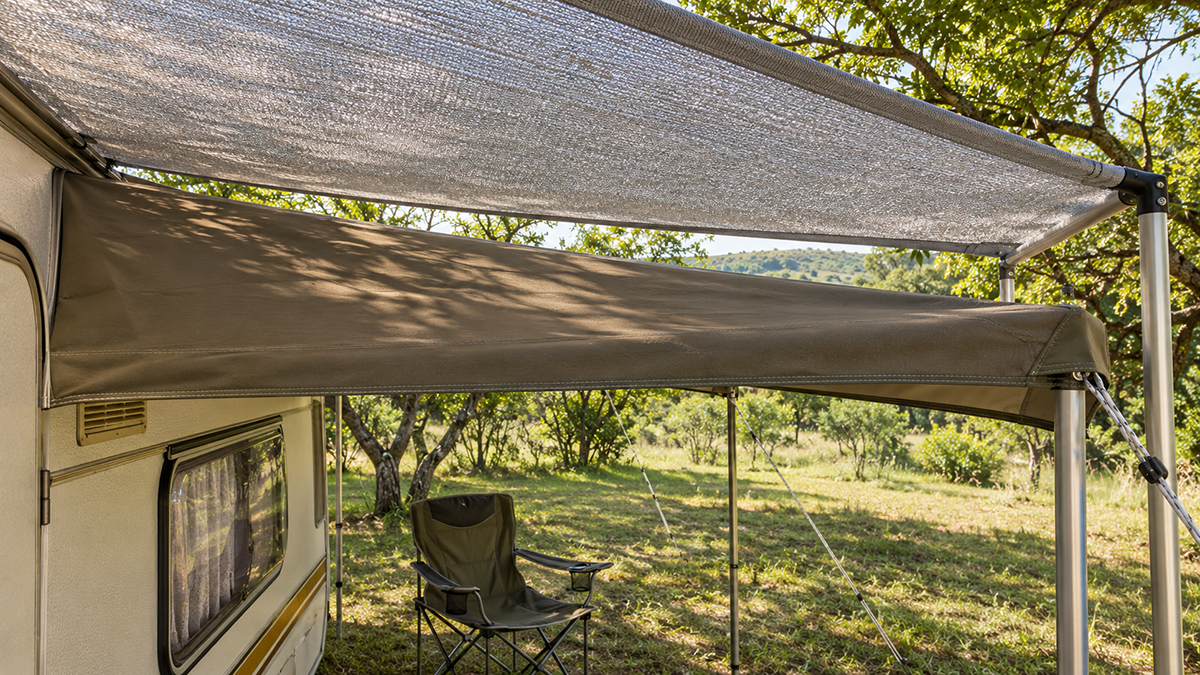
Stand at the front of a caravan tent and look along the roof from one end to the other. Your silver sheet may sit well above the ridge pole yet lie flat against the canvas halfway down the slope.
From your chair it all looks like shade. From the end of the tent you can see where air can actually pass between the two roofs.
How much gap should you leave?
Follow the clearance specified for your sheet and tent if the maker gives one.
For a separately supported summer cover, aim for enough clearance to keep most of the sheet off the canvas in an ordinary breeze, with open edges where air can enter and leave. There is no single gap in centimetres that suits a bow tent, a frame tent and a caravan rally awning equally well.
If you are still choosing between knitted silver shade net and solid reflective canvas, start with our guide, Do Silver Reflective Sheets Keep Tents and Caravan Awnings Cooler? Once you have chosen a material, the next decision is how to pitch it over the roof you already have.
What a double roof does in the sun
Think of an open-sided rally awning at midday. The air around your chair can be much the same temperature as the air elsewhere on the stand, yet you can feel the warmth coming off the underside of the canvas. The sun has heated the roof, and the warm roof radiates heat towards you.
Opening another side panel may give you a welcome breeze, but the canvas overhead is still in the sun.
A silver sheet changes which surface the sun reaches first. Its upper face reflects some sunlight, the material absorbs some, and an open knit lets some through. The canvas underneath therefore receives less direct sun. Even a sheet resting on the roof can provide shade.
Lifting the sheet adds two benefits.
First, it reduces the area where the sun-warmed cover can pass heat to the tent fabric by direct contact. Second, outside air can move through the space and carry some heat away before it reaches the roof below. Heat can still radiate across that space.
The advantage comes from shading the canvas and giving the warmed air somewhere to go.
That explains why a shaded roof can feel more comfortable overhead even when a thermometer at chair height records little change. It also explains why the colour of the sheet alone cannot tell you how cool the tent will feel.
Where should the air enter and leave?
Imagine following a breeze across your roof. Can it get in under one edge of the sheet, pass over the canvas and leave at another edge?
A cross-breeze can move air from side to side. In calmer conditions on a sloping roof, warmed air can rise towards a higher opening if there is a way out and fresh air can enter lower down.
That is what happens when you have a reflective sheet that lets air through.
A caravan tent presents a particular challenge. On many awnings the high edge runs along the caravan wall. If the silver sheet also ends at that wall, air rising up the slope meets a closed end. Look along the front and rear ends of the awning. Keeping these ends open can give air another route through the gap without altering the caravan rail.
A generous overhang introduces a trade-off. It can shade the sidewall when the afternoon sun drops, but pulling the whole edge down against the wall can close the opening you were relying on. Check the shade from your chair at the hottest time of day. You may only need the extra side shade at the western end.
How to check the gap on your own tent
Pitch the tent or awning fully before you fit the cover. An outer sheet can hide a slack flysheet or a poorly tensioned roof panel. Once both roofs are up, check them from the ground.
| Where to look | What to look for | What to adjust |
|---|---|---|
| Halfway between supports | A wide section of sheet hangs onto the canvas even though the corners are high. | Check the span and use the support points provided for the cover. Pulling harder on the corners can leave the middle low while putting more strain on the fittings. |
| Along the eaves | The edge folds down and rests against the roof or covers a vent. | Reposition the edge within the fitting instructions so air can enter underneath. |
| At the ridge | The cover bears on a seam or moves back and forth across a pole end. | Check the position and fit of the intended ridge support. Look for a smooth contact surface that spreads the pressure. |
| In a light breeze | The sheet repeatedly slaps the same patch of canvas. | Check the guys and the unsupported section while conditions are manageable. Repeated rubbing matters more than a momentary touch. |
A fitted cover may be designed to rest on a ridge band or another reinforced point. That contact is part of the design. Concentrate on the unsupported panels either side of it. A well-positioned ridge support is doing little for ventilation if the two broad slopes still lie together.
A bow tent, a frame tent and a rally awning need different pitches
On a bow tent with a factory flysheet, there is already a gap between the inner tent and the fly. A silver cover creates another layer above the fly. Fit the original fly as intended and keep its vents clear. If the silver sheet pushes the fly down onto the inner tent, you have lost the separation the tent maker built in. A knitted shade cover also lets rain through, so the original waterproof fly still has a job to do.
On a canvas frame tent, sight along both roof slopes. The ridge and outer corners can look right while the longest unsupported panel sags. Check the section directly above the sleeping compartment, especially if it occupies the western end. Raising the ridge further may achieve less than correcting the sag over that one section.
On a caravan rally awning, pay particular attention to the long outer edge. It is tempting to pull a wide sheet over the front poles and drop it like a curtain for extra shade. Before securing it there, sit underneath. If you have blocked the breeze at head height as well as the opening above the canvas, you may have traded away much of the comfort you wanted.
Does the same pitch work for netting and solid silver canvas?
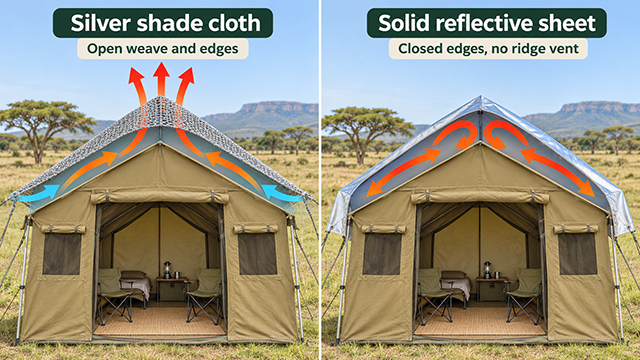
Knitted silver shade net lets some air pass through the material itself. That gives warm air another route out, although a net lying across a broad area of canvas still has little room for air to move underneath. Rain can pass through the knit. Check that the tent roof beneath it retains its normal shape and can drain freely.
With a solid silver sheet, air between the roofs relies more heavily on the openings around the perimeter. If the sheet is waterproof and intended to shed rain, it also needs a continuous fall towards an edge. Stand at the low side and trace the route a drop of water would take. A hollow behind a raised corner can collect water, pulling the sheet down onto the very patch of roof you wanted to keep clear.
With either material, take the extra cover down ahead of strong wind if the forecast exceeds the maker’s guidance or you cannot keep it secure. Raising a large sheet for more clearance also exposes more of it to gusts. Use supports and attachment points intended for the load.
Why is the tent still stuffy under a well-pitched silver sheet?
There are two separate air spaces to consider. One lies between the silver sheet and the roof. The other is the space you sleep or sit in. Air can move freely through the first while the second stays closed up.
You can tell the difference on a humid coastal evening. If the roof has been in shade for hours but the sleeping compartment feels close, check the inner mesh panels, windows and sheltered vents before changing the silver sheet. Moisture from breathing and damp kit still needs a route outdoors. A second roof cannot by itself prevent condensation overnight.
On a Highveld afternoon, try a different check. Look at the patch of sunlight on the floor or chair. If the low sun is now reaching you through the open west side, increasing the gap above the ridge will do little for that particular problem. Shade the exposed area while preserving the breeze through the awning.
The most useful check takes a minute. Look along the roof for broad contact, follow the air path from one open edge to another, then sit where you normally sit.
Those three views tell you whether the next adjustment belongs above the roof, at the edge of the sheet or inside the tent.
1 thought on “Air Gaps and Double Tent Roofs”
Comments are closed.