
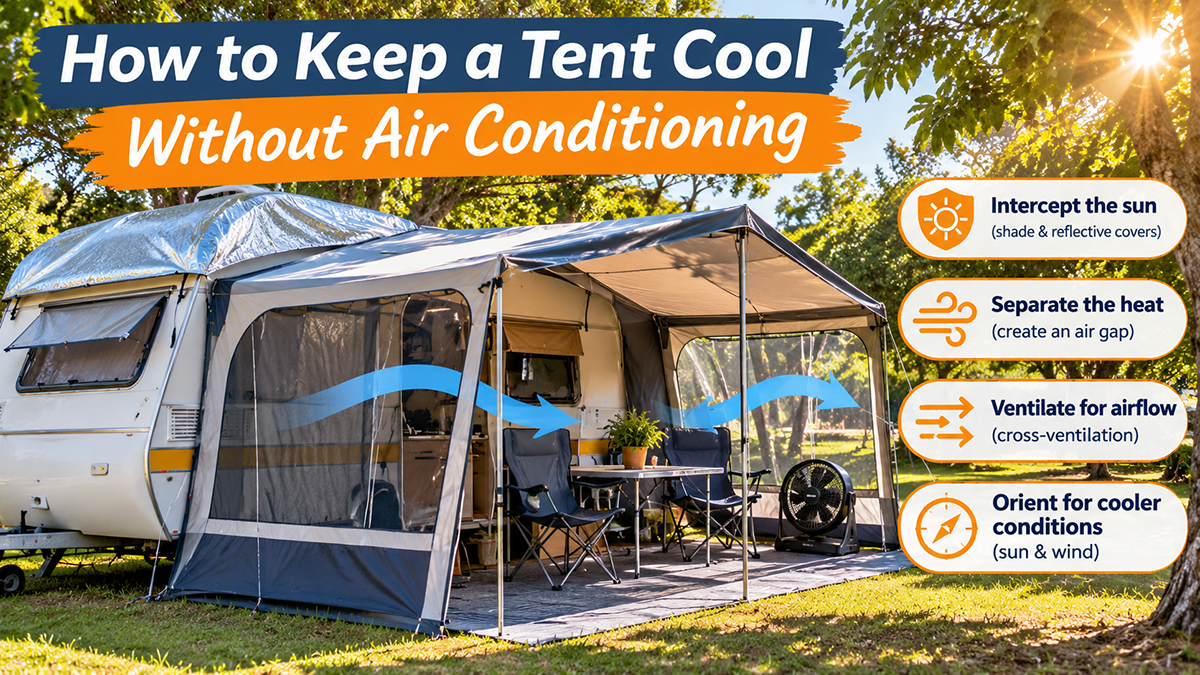
The most effective way to keep a tent or caravan cool without air conditioning is to reduce the amount of heat entering the camping setup while creating conditions that allow heat to escape.
A combination of shade, reflective covers, natural ventilation and correct campsite positioning can make camping considerably more comfortable.
South African campers are no strangers to extreme summer temperatures. Whether you are camping in the Bushveld, the Northern Cape, the Lowveld or along the KwaZulu-Natal coast, managing heat can be as important as protecting your tent against wind and rain.
While air conditioning is becoming increasingly popular among caravan owners, it is not always practical, affordable or even necessary.
For centuries, people living in some of the hottest regions of the world have used natural methods to manage heat inside their shelters.
Many of these principles can be applied to modern camping.
Why do tents and caravans become so hot?
A camping setup is constantly exchanging heat with its surroundings.
Heat enters through the roof, walls, windows and floor. It can also come from nearby vehicles, paved surfaces, cooking equipment, refrigerators and even the people inside the tent.
Unlike a conventional house, most camping tents have very little insulation and limited ability to moderate temperature changes.
A tent standing in direct sunlight may therefore become considerably hotter than the surrounding outdoor air.
Caravans generally offer more insulation than tents, but their windows, roofs and exposed body panels remain important sources of heat gain.
The challenge is not simply to cool the air inside a tent. It is to manage the entire environment in which the tent and caravan are standing.
What we can learn from traditional Sahara desert tents
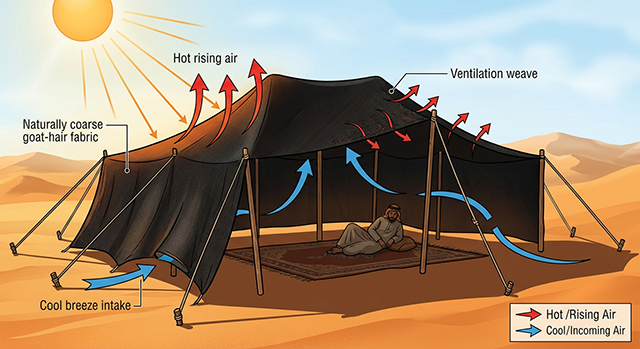
Although the construction of traditional desert tents varies between communities, many designs incorporate similar heat-management principles:
- Large shaded living areas.
- Open or adjustable side panels.
- Breathable woven materials.
- Natural ventilation.
- Protection against direct solar radiation.
- The ability to adjust the shelter as weather conditions change.
Traditional desert shelters are not necessarily designed to create a cold interior. Their purpose is to reduce exposure to heat and provide a more comfortable living environment.
Research into traditional Bedouin shelters has also examined the importance of air movement, temperature distribution and ventilation in hot climates. orbi.uliege.be
Modern campers can apply many of these principles without changing the basic construction of their caravan or tent.
Understanding how heat enters your camping setup
There are four important physical processes involved in camping comfort: radiation, conduction, convection and evaporation.
Radiation
Radiant heat travels in the form of electromagnetic waves.
Direct sunlight is the most obvious source, but heated surfaces such as caravan panels, vehicles, rocks and paving also emit thermal radiation.
This explains why you can feel heat from a vehicle standing in the sun without touching it.
Conduction
Conduction occurs when heat moves through materials or between surfaces that are in contact.
When sunlight heats a tent roof, heat can travel through the fabric. A hot outer cover resting directly against the tent roof can also transfer heat through contact.
Convection
Convection is the transfer of heat through moving air.
Air warmed by a hot tent roof can circulate inside the tent. Natural breezes and ventilation can help remove this warmer air when conditions outside are favourable.
Evaporation
Evaporation removes heat when water changes from a liquid into vapour.
This is why perspiration helps cool the human body and why a damp cloth can feel cooler in a dry climate.
However, evaporative cooling becomes less effective as humidity increases.
The four principles of camping heat management
At RealWorldCamping, we approach camping heat management through four complementary principles.
Intercept: Reduce direct solar exposure before it reaches your tent or caravan.
Separate: Create space between the outer shade cover and the surface being protected.
Ventilate: Allow warmer air to escape and fresh air to circulate.
Orient: Position your camping equipment according to sunlight, wind and surrounding heat sources.
These principles work together. Improving one without considering the others may limit the effectiveness of your heat-management efforts.
Why shade alone is not enough
Providing shade is usually the first step towards keeping a tent cooler.
Shade reduces direct solar radiation reaching a surface, but it does not automatically remove heat from the surrounding air.
Consider standing under a large tree on a hot summer afternoon. The air temperature may be similar to that in the sun, yet you feel more comfortable because your body is receiving less radiant heat.
The same principle applies to a tent.
A reflective camping sheet can help reduce solar exposure, but if heat accumulates underneath the sheet or inside the tent, the benefits may be limited.
Shade and ventilation should therefore be considered part of the same system.
How a ventilated air gap helps keep a tent cooler
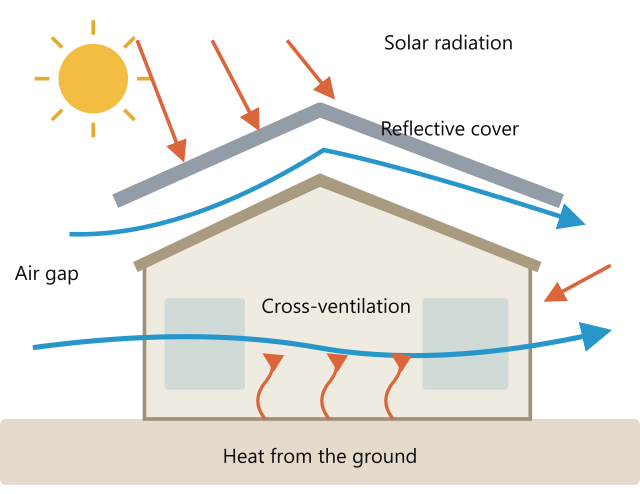
Separating an outer shade cover from the tent roof reduces direct contact and creates an additional path for air movement.
One of the most useful passive cooling methods is to create an additional roof above the existing tent roof.
This is sometimes referred to as a double-roof or second-skin system. Instead of placing a reflective sheet directly against the tent canvas, the sheet is supported above it, creating an air gap.
This arrangement can provide three benefits:
- Reduced direct sunlight reaching the tent roof.
- Reduced heat transfer through direct contact.
- An opportunity for air to move between the two surfaces.
As air moves through the gap, it can carry away some of the heat released by the surfaces.
The United Nations’ technical guidance on tents for hot climates also recommends separated outer roof coverings with ventilated gaps. shelterprojects.org
There is no universal ideal air-gap measurement for camping tents. The effectiveness depends on airflow, roof shape, material, wind direction and installation.
A larger gap is not necessarily better if it compromises the stability of the reflective sheet during strong winds.
Related reading: Silver Reflective Camping Sheets for Tents and Caravans.
How to create cross-ventilation inside a tent
Cross-ventilation occurs when air enters through one opening and exits through another.
Opening a single tent window may provide some ventilation, but opening suitable windows or doors on opposite sides can create a more effective route for moving air.
Opposing openings create a path for air to move through the caravan tent.
To improve cross-ventilation:
- Open windows on opposite sides of the tent.
- Roll up removable side panels when conditions permit.
- Keep insect screens open to airflow.
- Avoid placing cupboards directly in front of ventilation openings.
- Use upper ventilation openings to allow warmer air to escape.
- Adjust openings according to wind direction.
Remember that ventilation does not necessarily reduce the interior temperature below the outdoor temperature. However, moving air can improve personal comfort and prevent unnecessary heat accumulation.
Understanding airflow around a caravan and tent
Airflow around a camping setup is just as important as airflow inside it.
A caravan is a relatively large obstruction. When wind encounters the caravan, some air moves over the roof, some moves around its ends and some forms turbulent areas behind it.
A caravan may shield its tent from a cooling breeze. Actual airflow changes with wind direction, surrounding objects and the campsite layout.
If the caravan stands between the prevailing breeze and the tent, it may reduce natural ventilation in the living area.
Nearby vehicles, solid windbreakers, boundary walls and neighbouring caravans can have similar effects.
During hot, calm weather, enclosing a campsite with solid windbreakers may unintentionally create a pocket of warm, stagnant air.
During windy weather, however, protection against damaging wind must take priority over cooling.
The objective is to manage airflow rather than eliminate it entirely.
How to position your caravan and tent in summer
Campsite positioning is one of the few heat-management methods that costs nothing.
Before erecting your caravan tent, consider where the sun will be during the hottest part of the afternoon and from which direction the prevailing breeze is likely to come.
Illustrative northern midday sun path. The actual summer sun path varies with latitude, season and location.
In much of South Africa, north-facing surfaces receive substantial solar exposure, while west-facing surfaces can become particularly uncomfortable during the afternoon.
Near and north of the Tropic of Capricorn, the midday summer sun can also be directly overhead or to the south.
When selecting a campsite:
- Prioritise afternoon shade where possible.
- Consider the position of caravan windows.
- Avoid unnecessary exposure to the western afternoon sun.
- Leave space between vehicles and tents.
- Take advantage of safe natural breezes.
- Avoid unhealthy trees and branches that could fall during storms.
A compass application on your cellphone can help you establish campsite orientation before unpacking.
Protect caravan windows against direct sunlight
Caravan windows can be a significant source of solar heat gain.
Although closing curtains or blinds may improve comfort, external shading has the advantage of intercepting sunlight before it reaches the window.
External window covers, reflective nose sheets and small awnings can help manage this exposure.
Where practical, external shading should allow air to circulate between the cover and the caravan window.
Permanent caravan ventilation openings must never be obstructed.
Related reading: Caravan Window Reflective Sheets.
Managing heat from the ground and surrounding objects
Campers often concentrate on sunlight entering from above while overlooking heat coming from below and from the sides.
During the day, exposed surfaces absorb solar energy. Some of that energy is subsequently released as heat.
Common sources include:
- Sand and exposed soil.
- Concrete and paved surfaces.
- Rocks and brick walls.
- Vehicle body panels.
- Caravan exterior surfaces.
- Outdoor cooking equipment.
A campsite with shaded grass or natural vegetation may offer more comfortable conditions than one surrounded by exposed paving and hot surfaces.
Parking your vehicle farther from the tent, where practical, may also reduce radiant heat exposure.
Shading the surrounding living area rather than only the tent roof can improve overall campsite comfort.
Does the colour of a tent affect its temperature?
Colour can influence how much solar energy a material absorbs.
Lighter colours generally reflect more incoming solar radiation than darker colours of similar construction.
The South African Bureau of Standards also identifies light-coloured roofs and external shading as measures that can help reduce building heat gain.
However, colour alone does not determine the thermal performance of camping fabric.
Other factors include fabric thickness, weave, coatings, solar reflectance and ventilation.
Traditional desert tents sometimes use dark woven materials. Their overall thermal performance depends on more than colour, including their construction and ventilation.
Similarly, a silver-coloured camping sheet is not automatically superior to every other shading material merely because it appears reflective.
Managing dry heat versus humid heat in South Africa
South Africa does not have a single summer climate.
A cooling technique that works well in Upington may be less effective in Richards Bay.
The South African Medical Research Council, working with local academic institutions, distinguishes between dry-heat and humid-heat conditions when recommending natural cooling methods.
Hot, dry conditions – Northern Cape and parts of the Karoo
Hot, humid conditions – KwaZulu-Natal coast and parts of the Lowveld
| Camping region | Typical summer challenge | Heat-management priority |
|---|---|---|
| Northern Cape | Intense dry heat | Shade and evening ventilation |
| Karoo | Dry heat and strong sunlight | Roof protection and shaded living areas |
| Bushveld | High daytime temperatures | Shade and airflow |
| Highveld | Heat and afternoon thunderstorms | Adjustable ventilation and storm readiness |
| Lowveld | Heat and periods of high humidity | Air circulation and extensive shade |
| KwaZulu-Natal coast | Humid heat | Personal cooling and ventilation |
| Western Cape | Dry summer heat and strong winds in many areas | Shade with secure anchoring |
| Eastern Cape coast | Variable coastal humidity and wind | Flexible ventilation and shade |
These are broad regional characteristics rather than fixed conditions. Local forecasts and campsite geography remain important.
Camping in dry heat
In dry climates, evaporation can provide useful personal cooling. Cooler night-time temperatures may also allow campers to remove accumulated heat from the caravan.
Camping in humid heat
In humid conditions, perspiration evaporates more slowly, reducing the body’s ability to cool itself.
Air movement across the skin becomes particularly valuable.
Adding unnecessary moisture to the tent may make conditions less comfortable rather than improving them.
Using fans without air conditioning
A fan does not operate in the same way as an air conditioner.
- An ordinary fan does not actively remove heat from the caravan or tent. Instead, it moves air and can improve cooling through evaporation from the skin. Fans can also help remove accumulated warm air when positioned near an appropriate opening.
- Useful camping options include rechargeable fans, USB-powered fans, 12V caravan fans and conventional pedestal fans where electricity is available.
- Two smaller fans positioned appropriately may sometimes provide more useful circulation than one larger fan placed in a corner.
- Fans can be used for personal comfort or to assist ventilation through a suitable opening.
- During extreme heat, fans alone may not provide sufficient cooling. Access to a genuinely cooler environment becomes more important.
Evaporative cooling while camping
Evaporative cooling is one of the oldest methods of managing heat without refrigeration.
In dry conditions, the evaporation of water can remove heat from a surface or from air passing over a damp material.
Simple camping applications include using a damp cloth around the neck, wetting exposed skin and using a breeze or fan to assist evaporation.
Portable evaporative air coolers also use this principle.
However, these devices are not conventional air conditioners.
| Feature | Evaporative cooler | Air conditioner |
|---|---|---|
| Cooling method | Water evaporation | Refrigeration cycle |
| Best conditions | Hot, dry air | Wider range of humidity conditions |
| Adds moisture | Yes | Generally removes moisture from cooled air |
| Electricity consumption | Generally lower | Generally higher |
| Ventilation requirements | Needs fresh air | Usually works best in an enclosed space |
An evaporative cooler may be useful in the Northern Cape but much less effective along the humid KwaZulu-Natal coast.
How to keep a tent cooler at night
Cooling a tent or caravan does not end when the sun sets.
Vehicles, furniture, bedding and other materials may continue releasing heat absorbed during the day.
In areas where outdoor temperatures fall substantially after sunset, use the cooler evening and early morning air to remove accumulated heat.
Open suitable windows and vents, encourage cross-ventilation, and avoid unnecessary internal heat sources.
Where safe, keep insect-screened openings available overnight.
During hot and humid nights, directing a fan towards the sleeping area may provide more comfort than simply circulating air near the roof.
Common camping heat-management mistakes
Some well-intended camping practices can unintentionally make a campsite hotter.
| Mistake | Possible consequence |
|---|---|
| Covering the tent completely with a non-breathable sheet | Restricted ventilation |
| Closing every side panel | Accumulation of warm air |
| Blocking ventilation with camping cupboards | Reduced air circulation |
| Parking vehicles close to the living area | Additional radiant heat |
| Using solid windbreakers in calm weather | Reduced natural airflow |
| Cooking inside an enclosed tent | Additional heat and moisture |
| Using evaporative coolers in humid weather | Increased humidity |
| Ignoring the afternoon sun | Prolonged solar exposure |
| Relying entirely on a reflective sheet | Other heat sources remain unmanaged |
| Waiting until the tent becomes hot | More accumulated heat to remove |
Preventing unnecessary heat gain is generally easier than trying to remove accumulated heat afterwards.
Never use charcoal braais or outdoor combustion appliances inside an enclosed tent or caravan.
A practical summer camping heat-management checklist
Summer camping checklist
Summer Camping Heat-Management Checklist
Use this checklist to prepare your tent and caravan for hot summer camping conditions.
Intercept. Separate. Ventilate. Orient.
RealWorldCamping.co.za
Frequently asked questions
Can you keep a tent cool without air conditioning?
Yes. External shade, reflective roof coverings, ventilation, campsite positioning and fans can help reduce heat exposure and improve camping comfort. However, passive cooling cannot guarantee comfortable or safe temperatures during extreme heat.
Do silver reflective sheets keep tents cooler?
Silver reflective sheets can reduce direct solar exposure and radiant heat reaching a tent roof. Their overall effectiveness depends on material properties, installation, ventilation and environmental conditions.
Should a reflective sheet touch the tent roof?
Where practical and safe, separating the reflective sheet from the tent roof creates an opportunity for additional ventilation and reduces heat transfer through direct contact.
How big should the air gap be between a tent and a reflective sheet?
There is no universal recommended gap for every camping setup. The important considerations are sufficient separation, air movement, secure installation and wind resistance.
Is it better to open or close tent windows on a hot day?
Opening windows is generally beneficial when it allows warmer internal air to escape or improves personal comfort. If the outside air is substantially hotter than the inside, temporary closure of selected openings may help preserve cooler conditions. Permanent safety vents must remain open.
Can a fan cool a tent?
A fan improves air circulation and can improve personal comfort. It can also help exchange warm internal air with cooler outdoor air, but it does not refrigerate the air.
Does putting a wet towel in front of a fan work?
It can provide some evaporative cooling in dry conditions. In humid climates, it may provide little benefit while increasing moisture inside the tent.
Are dark tents hotter than light-coloured tents?
Dark fabrics generally absorb more solar radiation than comparable light-coloured fabrics. However, overall tent temperature also depends on ventilation, fabric construction, external shade and other environmental factors.
Can shade cloth be used instead of a silver reflective sheet?
Yes. Suitable shade cloth can reduce solar exposure. Its performance depends on its solar transmission, reflectance, construction and installation rather than its colour alone.
Can a tent become cooler than the outside air without air conditioning?
Under certain conditions, evaporative cooling or retained cooler night-time air can produce temperatures below the current outdoor air temperature. However, shade and ordinary ventilation alone generally cannot maintain substantially lower air temperatures throughout a hot day.
What is the cheapest way to keep a tent cooler?
Using available natural shade, positioning the tent correctly, opening suitable ventilation panels and reducing internal heat sources are among the least expensive methods.
When is air conditioning necessary while camping?
Air conditioning may become necessary when passive cooling cannot maintain safe or comfortable conditions, particularly during prolonged heatwaves, very humid weather or when camping with people who are vulnerable to heat-related illness.
Think of your campsite as a heat-management system
- Keeping a tent comfortable in the South African summer does not necessarily require expensive equipment. It requires an understanding of where heat comes from, how it enters the camping setup and how it can escape.
- Traditional desert communities have long applied natural heat-management principles that remain relevant to modern camping.
- By combining external shading, ventilated air gaps, cross-ventilation and intelligent campsite positioning, campers can reduce their dependence on mechanical cooling.
- A reflective sheet is not an air conditioner. It is one component of a broader camping heat-management system.
Intercept. Separate. Ventilate. Orient.
That is the foundation of passive camping heat management.
Research and references
The following publications informed the article:
- South African Medical Research Council – Responding to Different Types of Heat and Local Climate (2026).
- South African Bureau of Standards – Tips to Keep Cool in Buildings During Summer (2022).
- United Nations – Technical Guidance on Tents and Climate.
- Assessing the Thermal Performance of Bedouin Tents in Hot Climates (2014).
- Passive Solar Systems for the Promotion of Thermal Comfort in African Countries: A Review (2022).
1 thought on “How to Keep a Tent Cool Without Air Conditioning”
Comments are closed.