
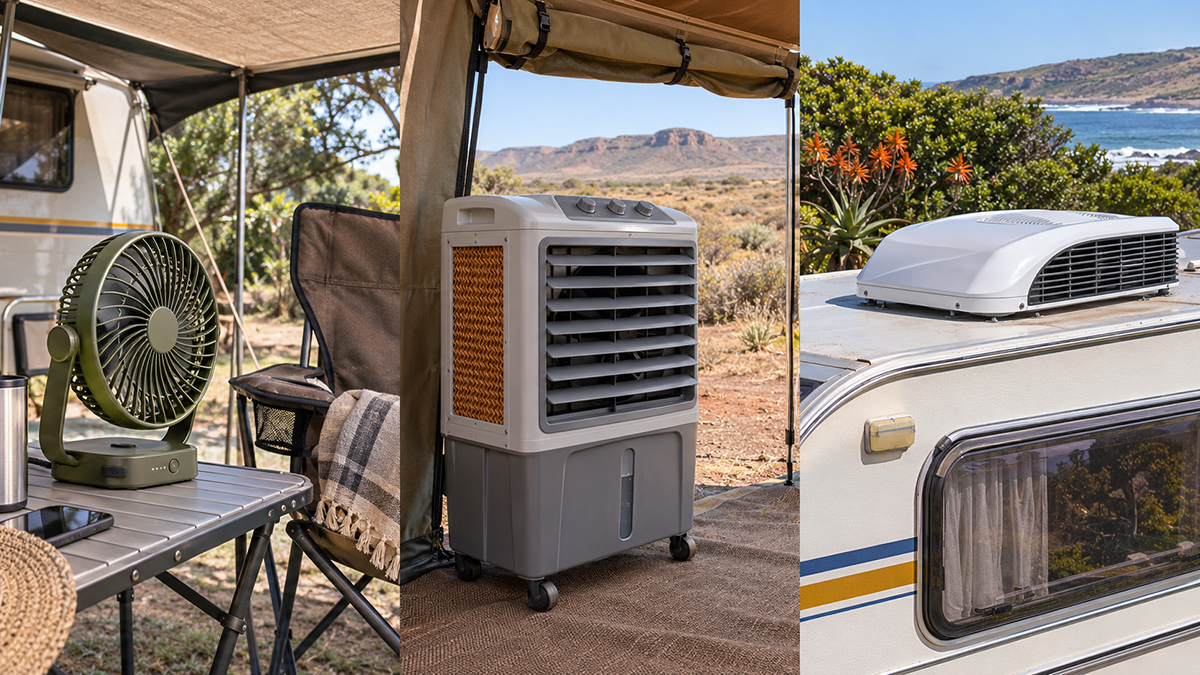
At three in the afternoon you want a breeze where you sit under the awning. At ten that night you want to sleep in a caravan that still feels hot and sticky. The appliance that solves the first problem may do very little for the second.
For most tent campers, start with a fan.
It gives you a breeze where you need it, packs easily and can run on a battery. A portable evaporative cooler earns its space on a hot, dry stand with water and good through-flow. If you regularly lose sleep in a humid caravan and camp on powered stands, compressor air conditioning is the option that can both lower the temperature and remove moisture.
Which cooling option suits your campsite?
| Your situation | First choice | What makes it work |
|---|---|---|
| You sit under an open-sided awning | Fan | Aim the breeze at your chairs. There is little point trying to cool all the air passing through the awning. |
| You sleep in a tent on an unpowered stand | USB or 12 V fan | Choose a speed you can sleep with and check that your battery will last the night. |
| You spend hot, dry afternoons on a Karoo stand | Evaporative cooler, if water and power are available | Draw in dry outside air and give the damp air a clear way out. Sit in the cooled airstream. |
| You sleep in a caravan on a muggy KwaZulu-Natal coastal night | Caravan air conditioner, if the stand can supply it | Cool the sleeping compartment and keep the door to the add-a-room closed. |
| Your tent is hottest before sunset but the outside air has already cooled | Ventilation, with a fan if needed | Open a second vent and use the cooler outside air to flush out the heat before bed. |
A camping fan works best where you can feel the breeze
A fan moves air across your skin and helps sweat evaporate. In an open awning, that makes it useful even when the thermometer beside your chair barely changes. In a sleeping tent, position it where the breeze reaches your upper body at a comfortable speed. A small fan on a bedside crate can do more for one sleeper than the same fan hanging high under the ridge. How fans and ventilation work
After sunset, check the air outside. If it is cooler than the sleeping compartment, open a shaded inlet and a second opening across the tent. A fan facing out through the second opening can help draw cooler air past the beds. Once the tent has aired out, turn the fan towards the sleepers if the night is still.
Check battery life at the speed you actually use. One locally sold rechargeable mini fan lists six hours on low, four on medium and two on high. Even its longest setting falls short of an eight-hour night. For two people, also check whether the breeze reaches the far side of the bed. South African fan specifications
When is an evaporative cooler worth taking camping?
A direct evaporative cooler draws air through a wet pad. As water evaporates, the outgoing air becomes cooler and carries more moisture. Dry air gives the water room to evaporate. On a muggy evening the fan still blows, but wetting the pad delivers less extra cooling. South African Air Conditioning and Refrigeration Academy explanation
Look at the hourly humidity for the time you want cooling. A dry afternoon near Upington and a humid evening near Durban call for different packing decisions, even if the forecast temperatures look similar. One South African cooler manual recommends relative humidity of 60% or less for a noticeable temperature drop. Treat that as guidance for that model. Performance declines gradually as conditions become more humid. Evaporative cooler operating guidance
Where you put it matters. On a dry, sheltered stand, position a suitable unit near an opening so its intake gets fresh air. Aim the outlet past your chair or bed and leave an opening on the far side. Zipping the tent closed recirculates increasingly damp air and reduces the benefit. In an open awning, judge the cooler by what reaches your chair. A room-size claim on the box tells you little about that. South African guidance on evaporative airflow
Then consider what you have to carry. One 180 W floor model weighs 14 kg empty and holds 30 litres. A full tank adds roughly another 30 kg. That is a substantial appliance to pack for a weekend, and tank capacity alone does not tell you how often it needs filling. Check the clean-water supply, how the tank drains before travel, and whether the unit is suitable for the location. The cited model is intended for dry conditions. Model specifications and care instructions
When does caravan air conditioning justify the extra equipment?
Air conditioning makes the strongest case when the sleeping compartment stays warm and humid after sunset. A compressor system carries heat outdoors. Moisture also condenses on its cold indoor coil, which helps with the clammy feeling that can persist even with a fan blowing.
A caravan gives the unit a smaller, more enclosed space to cool than a full canvas add-a-room. Close ordinary windows and the connecting door while it runs, and keep permanent safety vents clear. If you are considering air conditioning for a tent, check that the manufacturer permits that use and that the tent meets its minimum floor-area and installation requirements. A room-size rating cannot predict the result under sunlit canvas.
Two portable designs are easy to confuse when shopping:
- A portable split caravan air conditioner has an indoor section and an outdoor section. Check that its brackets fit your caravan window, that the outdoor section can discharge heat freely and that you can carry and store both pieces. One locally available unit weighs about 21 kg and lists a cooling-mode draw of 565–585 W. Caravan split-unit specifications
- A single-hose portable air conditioner stands inside and blows hot air outdoors through a hose. Route the hose all the way into open air. If it ends in a zipped-up annexe, the annexe gets the waste heat. Check the manual for hose routing and condensate drainage, particularly on a humid coast. Portable air conditioner installation and drainage manual
How much power will you need overnight?
For battery planning, multiply electrical input in watts × hours of use to get watt-hours (Wh). Use the electrical input on the label. Cooling capacity, often advertised in BTU/h or kW, describes the heat an air conditioner can move.
| Example | Eight hours at the stated draw |
|---|---|
| Small fan drawing 10 W (illustrative) | 80 Wh |
| Evaporative floor cooler drawing 180 W | 1,440 Wh |
| Caravan split air conditioner drawing 580 W | 4,640 Wh |
These are constant-draw calculations using the examples above. Actual consumption depends on the setting and, for the air conditioner, how much of the night the compressor runs. A power station with 500 Wh of usable energy would supply a steady 580 W load for about 52 minutes before inverter losses, provided its inverter could run and start the appliance. That same battery has ample energy for the example fan overnight. Allow separately for the fridge and anything else sharing the battery.
On a powered stand, ask the resort for the amp limit at your particular point. Add the rated current of the appliances you expect to use together. For example, the caravan split unit above is listed at up to 2.7 A. A 2,000 W kettle draws about 8.7 A at 230 V. Together they exceed a 10 A supply before you count the fridge or battery charger. Check the air conditioner’s starting requirements as well. South African campsite grading criteria
Should you buy a cooler or shade the tent first?
If the awning is uncomfortable mainly when the afternoon sun strikes its roof or west-facing wall, start by shading the surface that gets hot. A silver reflective camping sheet above the roof can intercept direct sun. Leave an air gap with a route for warm air to escape, and check whether low afternoon sun still reaches the chairs from the side.
Then see what is still uncomfortable. If stepping into the shade solves most of the problem and all you miss is a breeze, pack a fan. If the air is dry and a breeze alone feels too warm, an evaporative cooler is worth considering. If the sun has been down for hours and the caravan bedroom is still hot and clammy, that is the clearest case for air conditioning.
Related RealWorldCamping guides: How to Keep a Tent Cool Without Air Conditioning · Silver Reflective Sheets for Camping.