How reflective tent canvas is made, with its advantages and disadvantages
Sit under a caravan awning on a hot afternoon and you can feel heat coming off the roof even when your chair is in the shade. Reflective tent canvas helps by reflecting some of the sunlight before the roof absorbs it. How the canvas is made matters, particularly if you expect the same material to keep you dry when an afternoon shower comes through.
How does tent canvas get its silver surface?
One way to make reflective tent canvas is to start with woven cloth and coat one face with a resin containing fine aluminium particles. Each part of the fabric has a different job.
The woven cloth gives the roof its strength. In ripstop canvas, heavier threads run across and along the fabric at intervals. Look closely and you can usually see the small squares they form. If the cloth catches on something sharp, these threads help limit how far the tear spreads. Ordinary ripstop and reflective ripstop can both have this grid.
The coating gives the canvas its reflective face. The resin holds the aluminium particles against the cloth. Once the coating has set, the fabric has a continuous silver surface that reflects part of the sunlight falling on it. A tent maker using this type of canvas positions the reflective face towards the sun.
The seams and edges turn a roll of cloth into a usable roof. The tent maker cuts the panels to shape and joins them to cover the roof span. For a loose sheet, the maker also finishes the edges and reinforces the points where the guy ropes attach. A waterproof coating can keep rain from passing through the cloth, but the seams must also keep water out. That distinction matters if you plan to sit under an overhang with no tent roof beneath it.
Is a silver camping sheet made the same way?
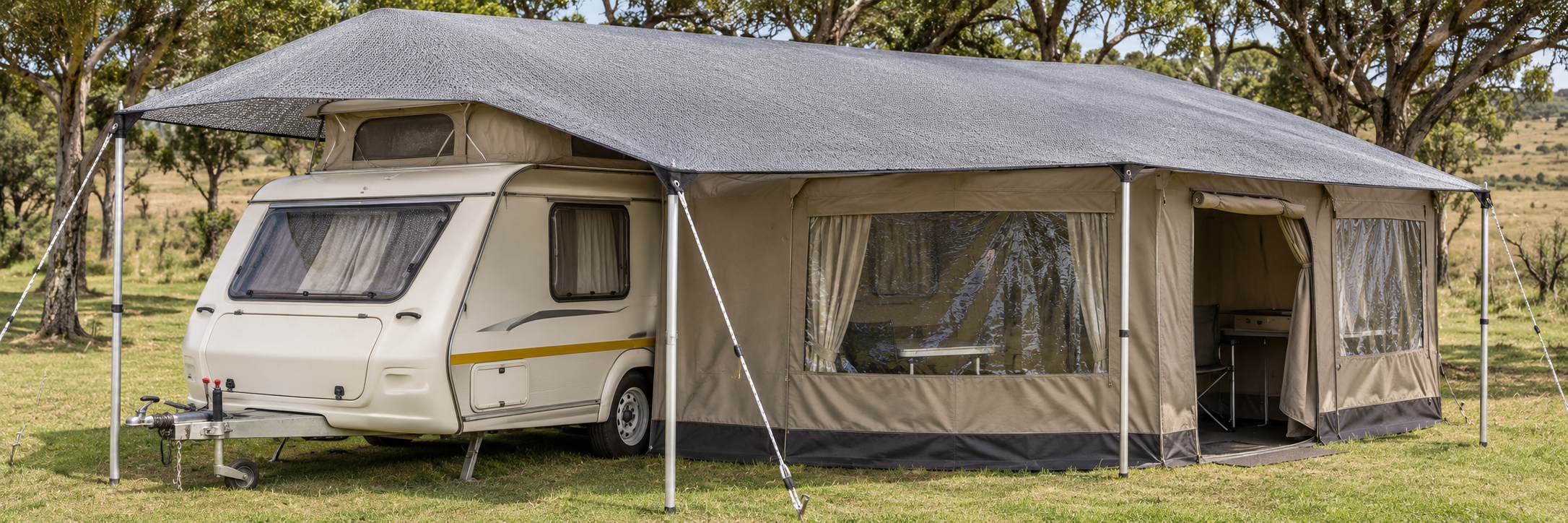
In South Africa, a silver seil can mean a solid coated cover or a knitted shade sheet. Hold a corner up to the light. On a knitted sheet, you can see small openings between the strands. The yarn forms interlocking loops, and the density of the knit helps determine how much shade it provides.
Those openings let some air through. They can also let fine rain through, even when much of the water runs down the slope. Over a watertight caravan tent, that may have little practical effect. Over the breakfast table outside the tent, it makes a difference. Silver colour alone tells you very little about rain protection.
What are the advantages of reflective tent canvas?
The main advantage is less heat from overhead. When the roof absorbs less sunlight, it can stay cooler and give off less heat towards the people sitting below. You may feel more comfortable under the awning even if a thermometer at chair height shows little change. On a stand with a breeze, the air moving past your chair is still the outside air.
A built-in reflective roof gives you this benefit each time you pitch the tent. A removable silver sheet lets you shade a roof you already own. For campers who stay on one stand for weeks, a separate sheet has another advantage. It takes much of the direct sun that would otherwise fall on the original canvas, and you can replace it separately when it wears.
What are the disadvantages?
A separate cover adds weight and takes time to pitch, dry and pack. For example, a 3 m × 5 m sheet cut from 300 g/m² canvas weighs 4.5 kg before the hems, reinforcement and ropes are added. If you move camp every few days, the work involved in handling a sheet that size may matter more to you than it would on a three-month stay.
A solid sheet also catches the wind. Its size, attachment points and the space available for guy ropes all affect whether it is practical on your stand. With a built-in reflective roof there is less to set up, although a worn coating can be more awkward to deal with because it forms part of the roof itself.
Finally, the silver finish only helps where it intercepts sunlight. If low afternoon sun reaches you through the open side of the awning, you can still feel hot beneath a well-shaded roof. A closed tent can also stay stuffy. No fixed temperature reduction applies to every pitch.
How long does reflective canvas last in the South African sun?
Count time on the stand as well as years of ownership. A sheet used for two weeks each December gets a different amount of sun and wind from one left up for an entire summer. The base cloth, coating and stitching can also wear at different rates.
On coated canvas, look first at the folds and the places where the roof touches a pole. A narrow dull or worn strip gives you a reason to check what rubs there when the wind blows. On a loose sheet, inspect the stitching around each attachment point while the fabric is spread out. It is easier to spot an eyelet starting to pull out then than when the sheet is folded in its bag. Follow the care instructions for the coating and dry the sheet before storing it.
For a long-term pitch, the practical choice comes down to the job you need the material to do. If the caravan tent already keeps the rain out, you can choose a separate sheet for the shade it provides.
If the silver canvas will also be the roof over your living area, give the waterproof finish and the seams as much attention as the reflective face.
1 thought on “How Reflective Tent Canvas Is Made”
Comments are closed.